

TeraWulf Inc. faces heightened volatility after its latest crypto-mining expansion update, though stocks have been trading down by 0 percent.
Key Takeaways WULF Traders Need To Know
- Amended Kentucky Power deal doubles Muskie Campus capacity to 1 GW and accelerates the second 500 MW phase to 2029, while adding $100M in winter bill credits and plant financing support.
- Morgan Stanley lifted its WULF price target to $65 and kept an Overweight rating, spotlighting TeraWulf’s AI-focused pipeline sites.
- B. Riley and Cantor Fitzgerald trimmed WULF targets but kept bullish ratings, still seeing 100%+ upside once AI funding worries ease.
- TD Cowen launched coverage of TeraWulf with a Buy rating and $21 target, arguing the market is too cautious on its leased data-center portfolio.
- Keefe Bruyette cut its WULF target to $20 but maintained Outperform, flagging strong AI colocation fundamentals yet limited near-term lease catalysts.
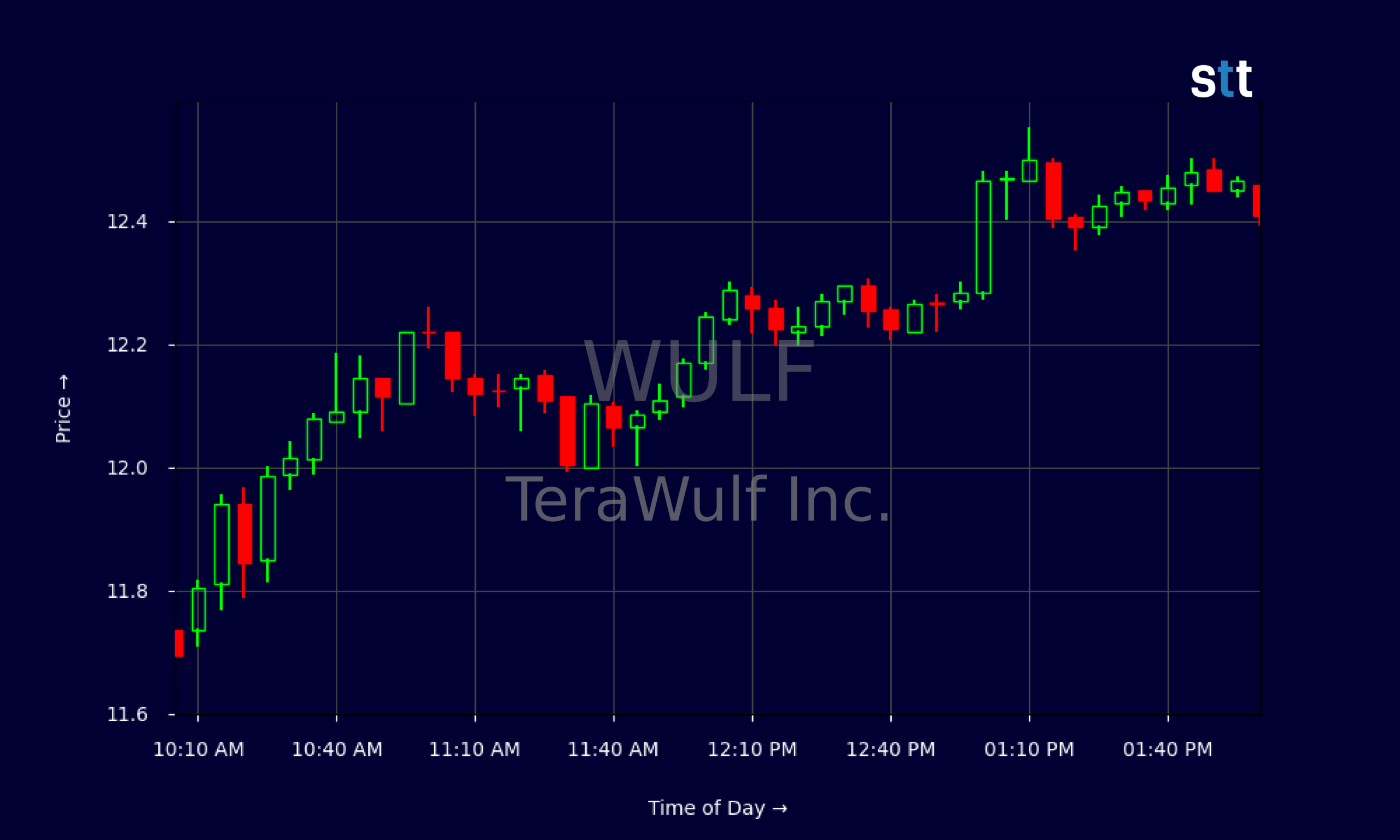
Live Update At 14:04:37 EST: On Tuesday, November 03, 2026 TeraWulf Inc. stock [OTC: WULF] is trending down by 0%! Discover the key drivers behind this movement as well as our expert analysis in the detailed breakdown below.
Quick Financial Overview
WULF has been trading like a high-voltage name. On 2026/11/03, TeraWulf opened near $11.08 and closed around $12.41 after pushing as high as $12.55. That is a strong intraday range and a solid push off the lows, telling traders momentum money is circling back into WULF after recent volatility.
Zooming out over the past few weeks, WULF has swung between roughly $10.35 and $13.91. The tape shows repeated dips into the low $11s getting bought, with snaps back into the $12–$13 zone. That kind of stair‑step action often signals aggressive dip trading and short-term trend followers leaning bullish.
Intraday, the 5‑minute chart shows a clean grind higher from the low $11s in premarket toward the mid‑$12s by early afternoon, with shallow pullbacks and tight consolidation. For active traders, that intraday structure screams “trend day” rather than choppy range.
More Breaking News
- Unity Software Stock Jumps As Google AI Deal Electrifies Bulls
- NuScale Power Rises 6% Despite Securities Lawsuit Reminder
- APP Stock Jumps After Big Earnings Beat And Bold Guidance
- AMZN Stock Rallies As AWS AI Boom Fuels Massive Capex Bet
Fundamentally, TeraWulf is still deep in build‑out mode. Revenue of about $168.5M runs into very heavy losses, with net income from continuing operations around -$940.8M and operating cash flow deeply negative. WULF’s gross margin near 84.3% reflects high‑value infrastructure, but profit margins are massively negative as capital spending ramps and the AI pipeline is still being built out.
Why Traders Are Watching WULF’s AI Power Bet
What keeps WULF on every momentum trader’s screen is not today’s earnings power, it is the AI infrastructure land grab. TeraWulf’s amended electric service agreement with Kentucky Power is the centerpiece. By doubling contracted power at the Muskie Data Campus from 500 MW to 1 GW and pulling forward the second 500 MW phase to 2029, WULF is locking in the raw energy needed to host serious AI and high‑performance computing workloads.
The trade‑off is real. TeraWulf agreed to fund $100M in winter bill credits for local residential customers and to cover estimated financing costs tied to Kentucky Power’s planned 760‑MW combined‑cycle plant at Big Sandy. For WULF traders, that means two things: stronger political and community support around a massive data‑center build, and additional financial obligations that sit on top of an already cash‑hungry build‑out.
Analysts so far are siding with the long‑term AI thesis. Morgan Stanley raised its WULF target to $65 and kept an Overweight rating, pointing to TeraWulf’s pipeline sites as strategically positioned for AI‑driven demand. Cantor Fitzgerald, even while cutting its target to $30, still called WULF a potential “generational buy” with 100%+ upside once funding fears and sector data‑center headwinds ease.
TD Cowen jumped in with a Buy rating and $21 price target, arguing the market is being too conservative on WULF’s leased data‑center portfolio, especially with Google‑backed Fluidstack support in the mix. B. Riley echoed the bullish stance, trimming its target to $26 due to higher rates but still framing recent share weakness as a buying opportunity. The counterweight is Keefe Bruyette, which cut its target to $20 and warned of valuation, financing, and regulatory risks, plus a likely drought in lease catalysts until early 2027. That divergence in targets is exactly what creates the trading swings WULF is known for.
Conclusion
For active traders studying WULF, the story is clear: TeraWulf is trading like a leveraged bet on the AI data‑center cycle. The company is shifting from pure bitcoin‑mining roots toward power‑backed digital infrastructure for AI and high‑performance computing at its U.S. campuses. The Muskie Data Campus expansion to 1 GW — with the potential for even more over time — anchors that pivot.
Financially, WULF’s numbers still look ugly. Net losses are huge, free cash flow is sharply negative, and valuation metrics like price‑to‑sales and price‑to‑book are elevated as the market tries to price future capacity, not current earnings. Balance‑sheet pressure is real: WULF is leaning on equity issuance and heavy capital expenditure to build out thousands of megawatts of capability while carrying meaningful debt.
Yet Wall Street coverage remains broadly bullish, with Buy or Overweight ratings from Morgan Stanley, TD Cowen, B. Riley, Cantor Fitzgerald, and Keefe Bruyette despite target cuts. Consensus still sees upside from current WULF levels, but timing depends on execution, financing conditions, and regulatory clarity around both AI infrastructure and crypto‑linked activities.
For traders, that mix sets up a classic momentum education case. As Tim Sykes likes to remind his community, “The market doesn’t care about your opinion — it cares about catalysts, price action, and risk management.” In the same spirit of disciplined trading, emotional control and preparation are crucial when dealing with a name as volatile as WULF; as Tim Bohen, lead trainer with StocksToTrade says, “The best trades are the ones you can make without emotion. Plan it, then execute it as if it’s routine.”. WULF’s catalysts are big, the price action is volatile, and risk management has to be front and center for anyone trading this AI‑power story. This analysis is for educational and research purposes only and is not investment advice.
This is stock news, not investment advice. StocksToTrade News delivers real-time stock market updates tailored to highlight the key catalysts driving short-term price movements. Our coverage is designed for active traders and investors who thrive in fast-moving markets, with a focus on volatile sectors like penny stocks, AI stocks, Robinhood stocks and other momentum plays. From earnings reports and FDA approvals to mergers, new contracts, and unusual trading volume, we break down the events that can spark significant price action.
Looking to level up your trading game? Explore StocksToTrade, the ultimate platform for traders. With powerful tools designed for swing and day trading, integrated news scanning, and even social media monitoring, StocksToTrade keeps you one step ahead.
Check out our quick startup guide for new traders!
- How to Read Stock Charts: A Guide for Beginners
- Trading Plan: 6 Steps to Create One
- How To Create a Stock Watchlist
Ready to build your watchlists? Check out these curated lists:
Once your watchlist is set, take the next step and trade with confidence using StocksToTrade’s robust platform. Don’t miss out — grab your 14-day trial for just $7 and experience the edge you need to thrive in today’s fast-paced markets.