

SoFi Technologies Inc. stocks have been trading down by -7.31 percent amid heightened concerns over regulatory scrutiny of its lending practices.
Key Takeaways
- Keefe Bruyette Woods cut its SoFi Technologies price target to $15 from $16 and reiterated an Underperform rating.
- The firm highlighted fair value accounting, higher interest rates, and rapid balance sheet growth as key pressures on SOFI.
- Analysts now see an estimated >$1B Q3 headwind that may fuel loan growth but drain capital, keeping risk high for SOFI traders.
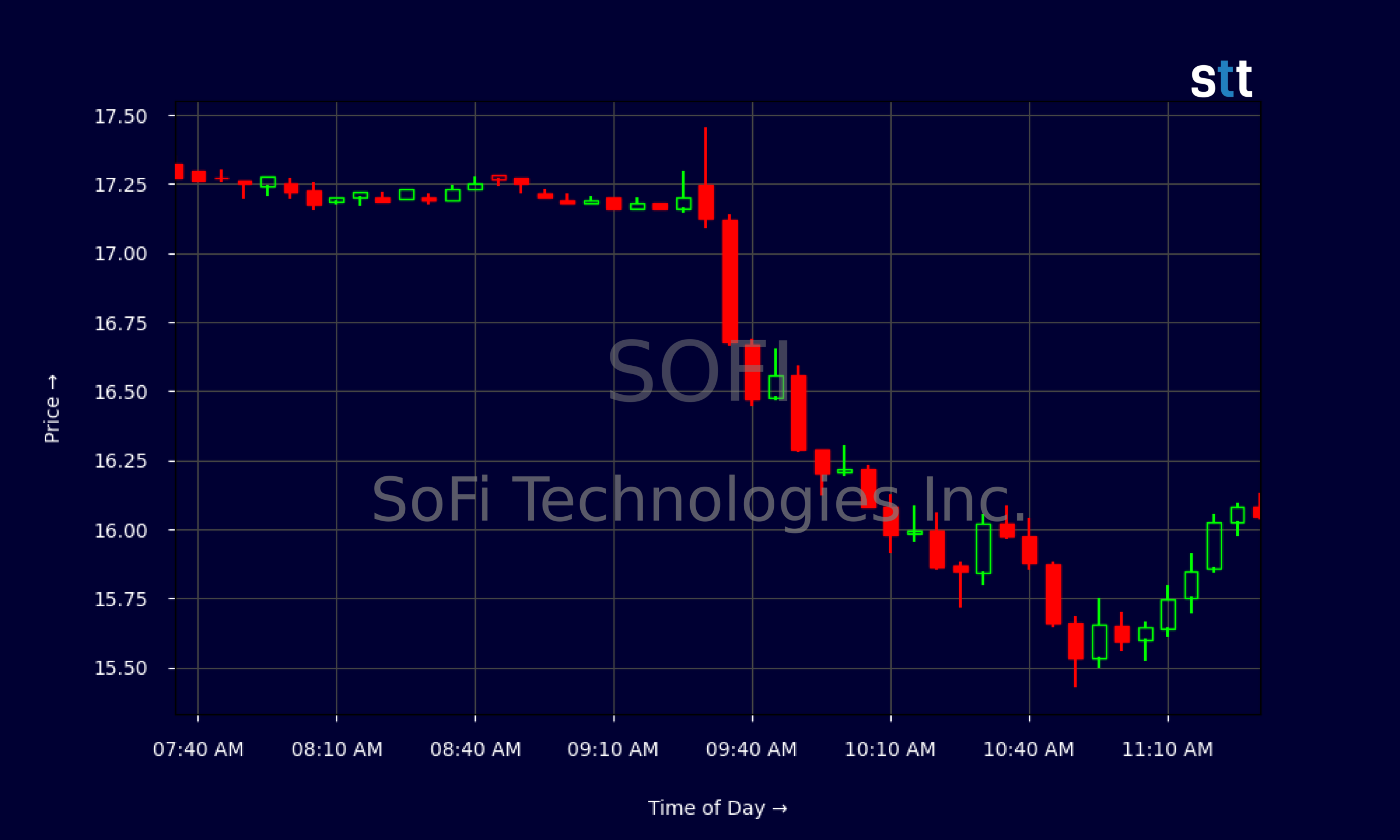
Live Update At 11:32:41 EST: On Thursday, November 05, 2026 SoFi Technologies Inc. stock [NASDAQ: SOFI] is trending down by -7.31%! Discover the key drivers behind this movement as well as our expert analysis in the detailed breakdown below.
Quick Financial Overview
SOFI has been grinding higher over the past few weeks, but the tape is getting choppy. From mid-October 2026, SoFi Technologies climbed from around $14.20 to above $17.60, a strong move for an already well-followed fintech. Now the stock is pulling back toward $16.00, with the latest daily candle showing a drop from a $17.24 open to a $16.05 close. That kind of intraday reversal tells traders that buyers are losing a bit of control.
Intraday 5‑minute action shows the same story. SOFI opened strong near $17.25, then steadily sold off, grinding down into the mid‑$15s before bouncing slightly. That’s classic distribution after a multi‑day run, not clean breakout behavior.
More Breaking News
- CDW Stock Climbs As Analysts Hike Targets And Board Strengthens
- Bentley Systems Stock Pops As Analysts Back Eliis Deal
- EOSE Stock Under Pressure As Legal Probes Mount
- NOK Stock Slides As Traders Question Rally After Earnings
Fundamentally, SoFi Technologies is posting real growth. Revenue is about $3.61B annually, rising more than 30% over three years and 40% over five. But SOFI trades at a rich price‑to‑sales of 4.74 and a P/E around 32. Profit margins are still relatively thin for a bank‑style business, with profit margin around 14.8% and asset turnover just 0.1, which means the company needs a big balance sheet to generate earnings. For short‑term trading, that leverage and valuation mix keeps SOFI sensitive to any negative headline.
Why Traders Are Watching SOFI After The Target Cut
Wall Street just threw cold water on the SOFI momentum story. Keefe Bruyette Woods lowered its SoFi Technologies price target to $15 from $16 and stuck with an Underperform rating. For an actively traded name like SOFI, that kind of call from a respected financial‑sector shop matters. It’s not just the $1 price cut; it’s the message behind it.
Keefe Bruyette argues that fair value accounting dynamics, higher interest rates, and very fast balance sheet growth are combining into an estimated >$1B headwind in Q3. Translation for traders: the way SOFI marks its loans and assets, combined with a rate environment that makes funding more expensive, may pressure reported earnings and capital even if headline loan growth looks strong.
SOFI has been growing its loan book aggressively, which helps revenue and headline EPS in the short term. But more loans also mean more risk on the balance sheet. Keefe Bruyette is basically saying SOFI’s engine is revving hard, while the gas gauge on capital is drifting lower. For traders, that’s a yellow flag.
Short‑term, this kind of Underperform reiteration can cap upside. The stock is already trading above the new $15 target, which gives bears a clear talking point. When SOFI rallies into the high‑$16s or $17s, many funds will look at that target and lock in gains or build shorts. That creates overhead supply.
At the same time, volatility is opportunity. SOFI has enough volume and liquidity for day trading, and sharp reactions to headlines like this often set up clean technical levels. Active traders watching SoFi Technologies now should be laser‑focused on how price behaves around $15 support and $17 resistance—those are the battleground zones that will reveal whether this downgrade becomes a real trend shift or just a shakeout in a bigger uptrend.
Conclusion
SOFI is a classic momentum name running into a reality check. The business is scaling fast, with more than $60B in assets and over $45B in deposits on the latest balance sheet. Revenue is rising, earnings are positive, and return on equity is improving. But the Keefe Bruyette Woods call reminds traders that rapid growth plus rising rates plus complex fair value accounting is a risky cocktail for a financial stock.
If SOFI keeps pushing loan growth while capital ratios slide, any macro shock or credit scare can hit the name hard. That’s what the >$1B Q3 headwind warning is really about—less room for error. For short‑term trading, that means respecting the downside as much as the upside. Sharp bounces off support can be playable, but overstaying when analysts are flagging structural pressure is dangerous.
This is where mindset matters. As Tim Sykes loves to say, “Cut losses quickly and move on — the market will always give you another opportunity.” And as Tim Bohen, lead trainer with StocksToTrade says, “If you’re still guessing at the end of your analysis, it’s probably not a trade worth taking.” SOFI traders who stick to that rule, trade the chart not the hype, and use levels like $15 and $17 as clear lines in the sand will be better prepared. The headline from SoFi Technologies is caution, not collapse—so the edge goes to disciplined traders who treat every move as a trade, not a promise.
This is stock news, not investment advice. StocksToTrade News delivers real-time stock market updates tailored to highlight the key catalysts driving short-term price movements. Our coverage is designed for active traders and investors who thrive in fast-moving markets, with a focus on volatile sectors like penny stocks, AI stocks, Robinhood stocks and other momentum plays. From earnings reports and FDA approvals to mergers, new contracts, and unusual trading volume, we break down the events that can spark significant price action.
Looking to level up your trading game? Explore StocksToTrade, the ultimate platform for traders. With powerful tools designed for swing and day trading, integrated news scanning, and even social media monitoring, StocksToTrade keeps you one step ahead.
Check out our quick startup guide for new traders!
- How to Read Stock Charts: A Guide for Beginners
- Trading Plan: 6 Steps to Create One
- How To Create a Stock Watchlist
Ready to build your watchlists? Check out these curated lists:
Once your watchlist is set, take the next step and trade with confidence using StocksToTrade’s robust platform. Don’t miss out — grab your 14-day trial for just $7 and experience the edge you need to thrive in today’s fast-paced markets.