

Amazon.com Inc. stocks have been trading down by -2.28 percent amid concerns over slowing e-commerce growth and margin pressures.
Key Takeaways Traders Need To Watch
- Truist projects that Microsoft’s major AI and cloud peers will run negative free cash flow under heavy AI infrastructure spending, raising questions about how far AMZN can push AI capex.
- Oppenheimer notes that Walmart’s new combined membership boosts value versus Amazon Prime and could help Walmart gain U.S. e-commerce and delivery share at the low-price end.
- AliExpress’s new Elite VIP program for big spenders in Europe and beyond is a targeted competitive jab at entrenched e-commerce players like Amazon, including high-frequency shoppers.
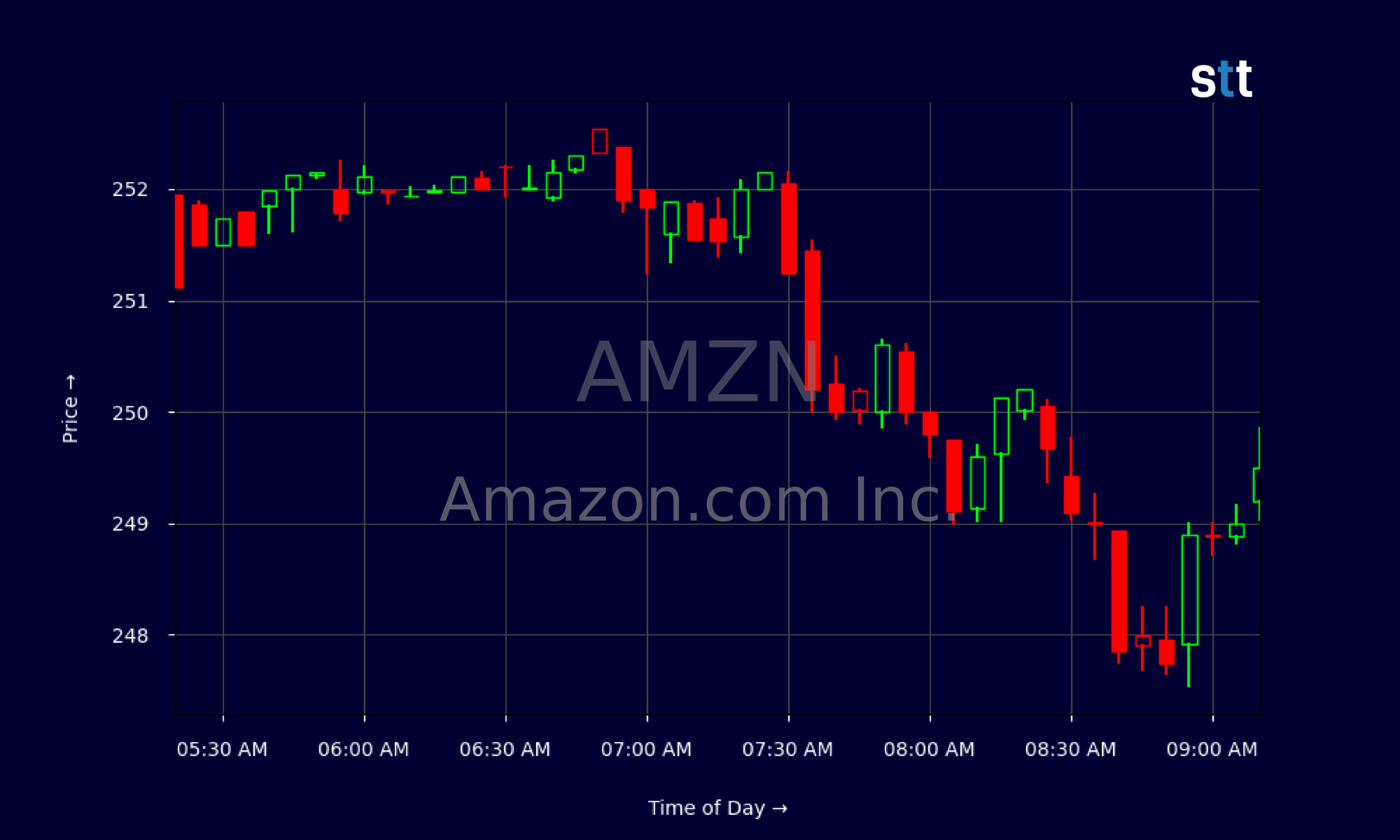
Live Update At 09:18:16 EDT: On Thursday, October 29, 2026 Amazon.com Inc. stock [NASDAQ: AMZN] is trending down by -2.28%! Discover the key drivers behind this movement as well as our expert analysis in the detailed breakdown below.
Quick Financial Overview
AMZN is trading in the mid-$250s, with recent daily closes mostly between $250 and $263. That range tells traders the stock is consolidating after a prior push higher. The last recorded close around $254.60, after a small bounce from the low $250s, signals buyers are still defending dips, but momentum is not screaming in either direction.
On the fundamentals, Amazon.com Inc. is posting about $716.9B in annual revenue with double‑digit growth over three and five years. A price-to-sales near 3.65 and a P/E around 21.1 are no longer nosebleed for AMZN, especially against its own history of a P/E that once topped 900. Margins look solid for a mega-cap retailer-cloud hybrid: gross margin near 50.8% and an EBIT margin around 23%.
More Breaking News
- HLN Stock Grinds Higher As Haleon Attracts Steady Trader Interest
- RIG Stock Climbs As Backlog Surges And Valaris Deal Nears
- GOOG Stock Slides As Core Ads Miss And Legal Risks Mount
- Microsoft Stock Pops As Cloud And AI Guidance Smash Expectations
The latest quarterly income statement shows $200.6B in revenue and $62.65B in net income, with EBITDA at a hefty $102.15B. Returns on equity above 30% and low leverage — total debt to equity about 0.23 — tell traders AMZN still has balance-sheet firepower to fund AI and logistics without leaning too hard on debt. The catch is cash flow: free cash flow for the recent period ran negative $8.82B, a flashing yellow light for anyone tracking heavy capex cycles.
Why Traders Are Watching Competitive Pressures On AMZN
AMZN sits at the crossroads of three pressure fronts: AI infrastructure spending, U.S. value retail, and international e-commerce. None is fatal on its own, but together they shape how traders read every tick in the chart.
Start with AI. Truist warns that Microsoft’s major AI and cloud peers are likely to run negative free cash flow as they pour money into data centers and chips. That club clearly includes Amazon Web Services. The data already show AMZN’s own free cash flow dipping negative, even while operating cash flow remains strong at about $45.39B. For traders, this is the classic “great story, expensive buildout” setup. The AI race can power long-term revenue, but in the near term, it drags on cash and makes the market less forgiving when AMZN misses.
Then there’s the core retail flywheel. Oppenheimer points out that Walmart’s new combined membership tightens the gap with Amazon Prime on value. When a price-focused giant like Walmart beefs up perks, that pressures Amazon.com Inc. at the low end — exactly where shipping speed and fees decide who gets the order. This is not a one-day headline; it’s a slow grind that can chip away at AMZN’s delivery volume and Prime pricing power over time.
Layer in AliExpress. Its Elite VIP program for high-spending customers in Europe and other markets is described as a “small but targeted” move, but it reminds traders that AMZN does not own the rest of the world. Each niche program aimed at high-frequency or price‑sensitive buyers forces Amazon.com Inc. to choose between defending share with deals and shipping subsidies, or protecting margins.
Put all of this against the price action: AMZN grinding sideways in a wide $248–$264 band while 5‑minute intraday candles show tight, liquid trading around $250–$252 in the premarket and early session. That is exactly what you expect when the story is strong but the market is waiting to see how much cash the company is willing to burn to stay ahead.
Conclusion
For active traders, AMZN is no sleepy mega-cap. The stock’s tight daily range and deep liquidity make it a favorite for both momentum and range setups, but the real edge comes from understanding what’s under the hood.
Amazon.com Inc. is throwing huge capital at AI, logistics, and infrastructure. The numbers back that up: more than $54.2B in capital expenditures in the latest period, and negative free cash flow despite strong operating cash. Truist’s warning about Microsoft’s AI peers running negative free cash flow lines up neatly with what AMZN’s own filings already show. The bet is simple — spend now, dominate later — but the market will punish any sign that returns are slipping.
At the same time, AMZN’s retail moat is facing steady erosion. Walmart’s beefed‑up membership program eats into Prime’s value lead in the U.S., and AliExpress’s Elite VIP push aims at high‑spend shoppers in Europe and beyond. None of these headlines alone break the AMZN bull case, yet they all nibble at future growth and margin assumptions traders often take for granted.
So how do you handle it as a trader? You focus on price, not hope. As Tim Bohen, lead trainer with StocksToTrade says, “I focus on what a stock is doing, not what I want it to do. Let the stock prove itself before you make a move.” In Tim Sykes’s world, rule number one is always the same: “Cut losses quickly; taking a small loss is fine, taking a big loss is not.” For AMZN, that means respecting your levels around this $250–$260 zone, watching cash‑flow trends versus AI capex, and refusing to marry the stock — no matter how strong the brand story sounds. This content is for educational and research purposes only and is not trading advice.
This is stock news, not investment advice. StocksToTrade News delivers real-time stock market updates tailored to highlight the key catalysts driving short-term price movements. Our coverage is designed for active traders and investors who thrive in fast-moving markets, with a focus on volatile sectors like penny stocks, AI stocks, Robinhood stocks and other momentum plays. From earnings reports and FDA approvals to mergers, new contracts, and unusual trading volume, we break down the events that can spark significant price action.
Looking to level up your trading game? Explore StocksToTrade, the ultimate platform for traders. With powerful tools designed for swing and day trading, integrated news scanning, and even social media monitoring, StocksToTrade keeps you one step ahead.
Check out our quick startup guide for new traders!
- How to Read Stock Charts: A Guide for Beginners
- Trading Plan: 6 Steps to Create One
- How To Create a Stock Watchlist
Ready to build your watchlists? Check out these curated lists:
Once your watchlist is set, take the next step and trade with confidence using StocksToTrade’s robust platform. Don’t miss out — grab your 14-day trial for just $7 and experience the edge you need to thrive in today’s fast-paced markets.