
I’m a big proponent of the OODA Loop. It’s a great methodology. Plus, it’s an intelligent way to approach trading.
If you’re unfamiliar, the OODA Loop is a framework for making decisions developed by United States Air Force Colonel John R. Boyd. He first presented OODA publicly in 1986, but he’d been thinking about it since his aerial combat days in the 1950s.
Prepare Now for Next Week’s Trades
Get My Weekly Watchlist and Research Video Here
Table of Contents
The Big Picture
What, exactly, is the OODA Loop?
It’s a four step decision making process:
- Observe
- Orient
- Decide
- Act
Here’s how the OODA Loop applies to trading (and it doesn’t matter what timeframe you trade).
Observe Raw Unfiltered Data: The Stock Scan
The scan is the “observe” part of the OODA loop.
Why start with a scan? Because there are 20,000 stocks out there. Can you look at 20,000 stocks every day? Of course not.
So, the very first thing you do in the trade process is initiate your scan, looking for stocks that meet the criteria you’ve set.
Now, it could be an RCT scan. It could be dip and rip, weak open red to green, or a Rubicon scan. But with every scan, we’re going back to a known and named setup.
Usually you’ll end up with a handful of stocks. For example, my Oracle algo kicks out 10 to 15 stocks every day.
Orient Into Situational Awareness
If you traded every stock that hit your scan, you’d blow up your account. Fast. So, the next phase is to filter the raw observation done by the scan into a small list of stocks.
So, now we take the scan and run it through our attributes that match that particular setup. Again, if it only gets through the scan, it doesn’t mean it fits all our attributes. It hasn’t made it through to an executable trade.
What usually happens in the orient stage is that your list of 10 stocks gets whittled down to two or three.
The next thing we do is…
Decide Which Stocks Fit and Write Trade Plans
So, we’ve gone from 20,000 stocks down to two or three.
Now we write a trade plan. Don’t write the trade plan until we’re down to the smallest number of stocks possible that fall within the criteria of that pattern and setup.
What’s next?
Act On the Trade Plan
This is where you execute the trade plan.
Notice I didn’t write “execute the trade.” Why? Because the trade plan tells us when to get in, our risk (stop loss), and target. If the stock doesn’t hit the entry signal we still follow the plan, which means to NOT take the trade.
It’s In the Name: The Final “Step” of the OODA Loop
Take a look at this diagram of Colonel Boyd’s OODA Loop framework:
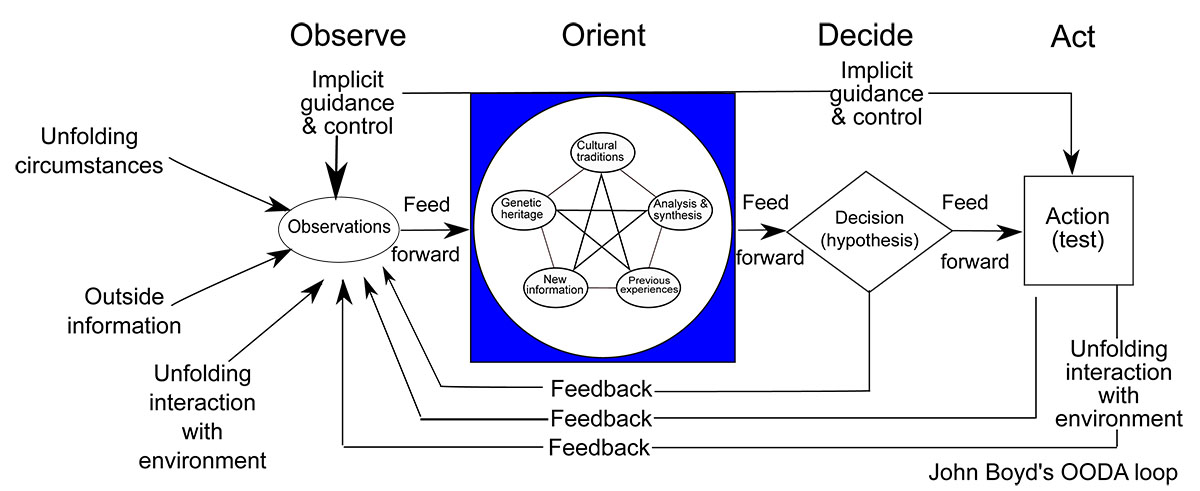
Source: Wikimedia Commons, OODA Loop diagram created by Patrick Edwin Moran
What some people miss (even those who say OODA is a great methodology) is that everything turns into a feedback loop. At every step of the decision making process, you loop back to step one: observe.
Now, this is extremely important in trading. Why? As Colonel Boyd wrote in Patterns of Conflict:
“[…] in order to win, we should operate at a faster tempo or rhythm than our adversaries – or, better yet, get inside adversary’s Observation-Orientation-Decision-Action time cycle or loop.”
In other words, the trader who can cycle through the OODA Loop faster than others has an advantage.
My Take
Remember, if you use the OODA Loop it doesn’t matter what the trade is. The process remains the same.
It could be a day trade. It could be a swing trade or a long-term hold. It could be any of the patterns. OODA applies to every single pattern, strategy, and timeframe.
So, start thinking through your trades using the OODA loop. I believe you’ll make better trading decisions AND get faster at it.
Watchlist
Many times former runner Lycyd, Inc. (NASDAQ: LUCY), formerly Innovative Eyewear, spiked yesterday (July 6) on positive earnings.
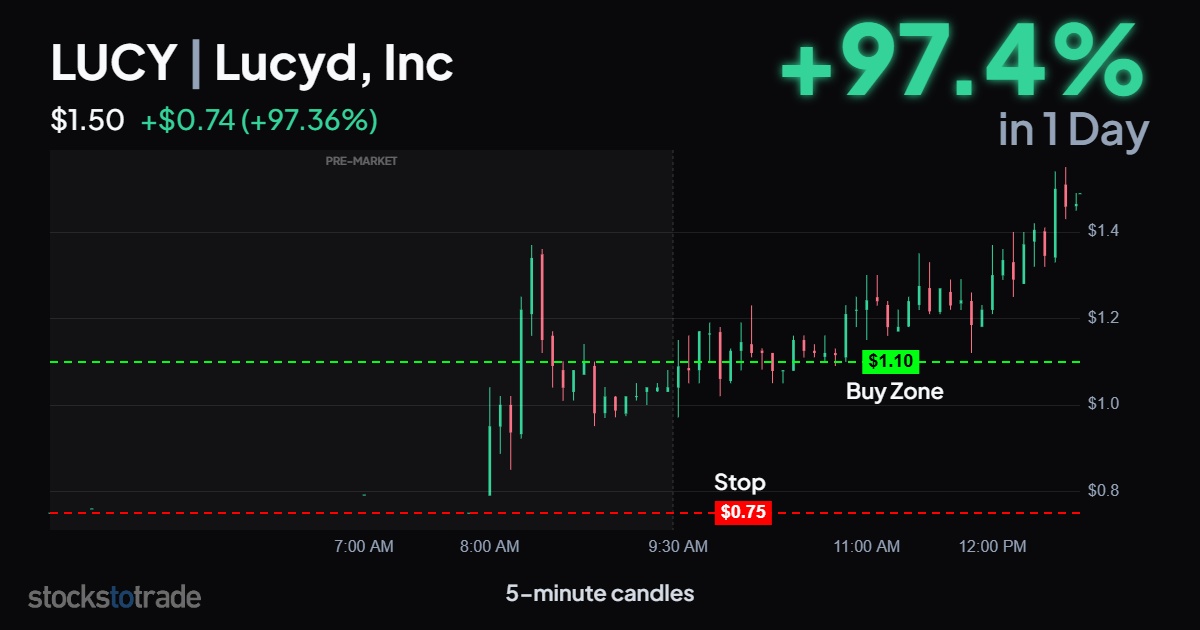
LUCY, 7/6/26, earnings winner, Oracle signal hit
LUCY was one of my Tops in PreMarket Prep and hit the Oracle entry early. Once the signal was set, it never came close to the $0.75 stop loss at any point on the chart above.
Now, I might not have held it through that choppy consolidation for 90 minutes, but anyone who used the Oracle trade plan was in with a winner.
On My Radar
- Samsung trades on the Korea Exchange but look for AI memory sector plays based on its Q2 earnings report today
- In a historical first yesterday, we witnessed the opening bell from the Oval Office
- At that same event, President Trump officially launched Trump Accounts
- Reminder that tomorrow (July 8) the Fed will release FOMC minutes from Kevin Warsh’s first meeting as chairman