

Did you see the Starlink news that SpaceX (Nasdaq: SPCX) dropped last week?
Starlink is about to be a phone company. Now, I agree that phones are going to be huge for SpaceX, but I think what they actually bought is bigger.
Here’s How I Spot Big Breakouts Before They Happen

Table of Contents
The Big Picture
Last Thursday (Oct. 8), SpaceX announced an agreement to buy a nationwide block of up to 14 megahertz of low-band spectrum for Starlink Mobile.
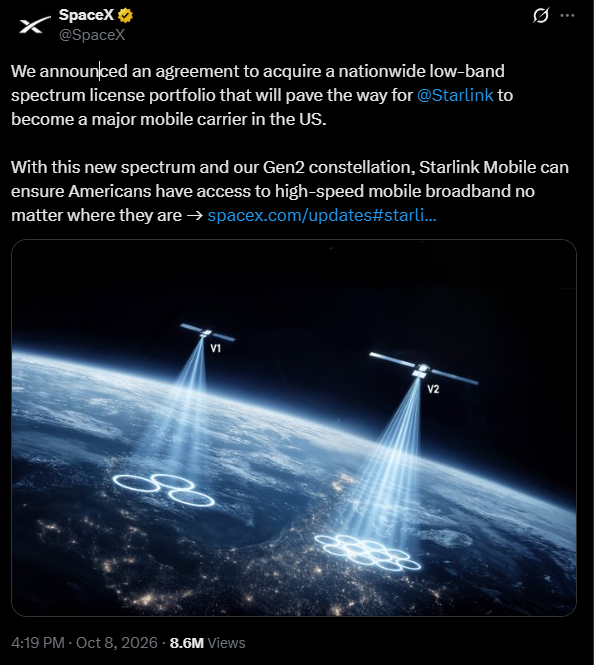
Now, it’s still pending FCC approval. But think about it…
Starlink already has bandwidth at 2GHz. That’s the speed.
But low-band signals are better at going through walls. It penetrates obstacles and works when devices are inside of buildings.
So, SpaceX is pairing its satellites with a ground network. Why is that important?
Because users won’t have to rely on a beam punching through a steel roof (or a wish).
Elon Musk called it the last piece for phone coverage. The traditional mobile carriers took a beating.
Verizon (NYSE: VZ) got destroyed on the news…
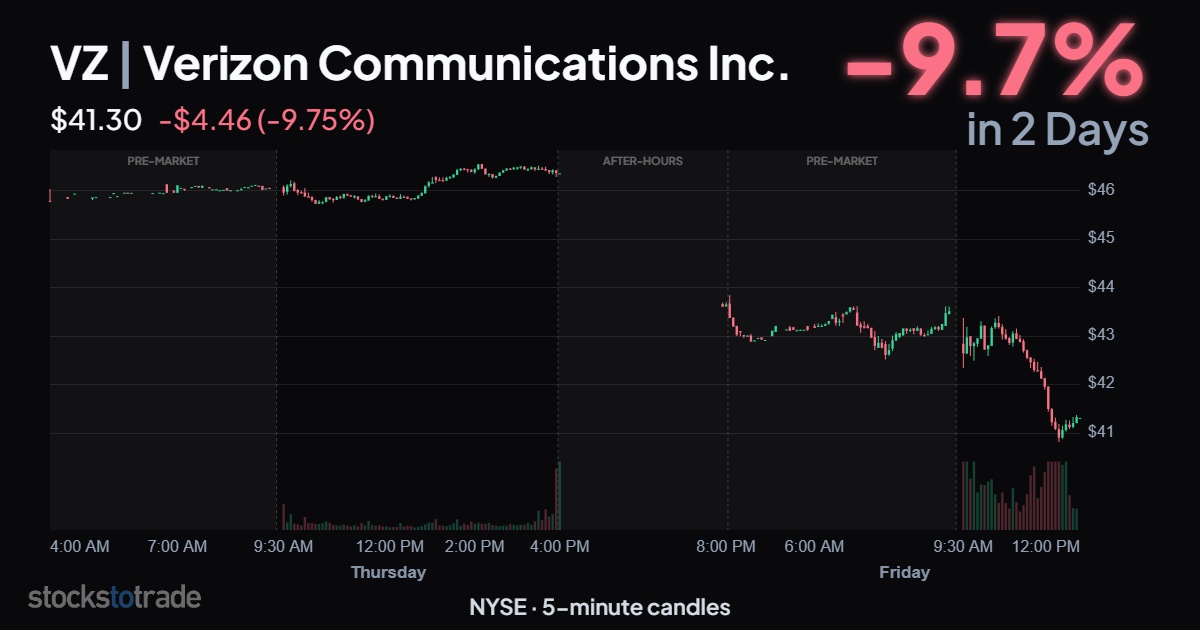
VZ 10-8-9/26, 5-min candles, market reaction to Starlink news
AT&T (NYSE: T) was eating dirt on it…
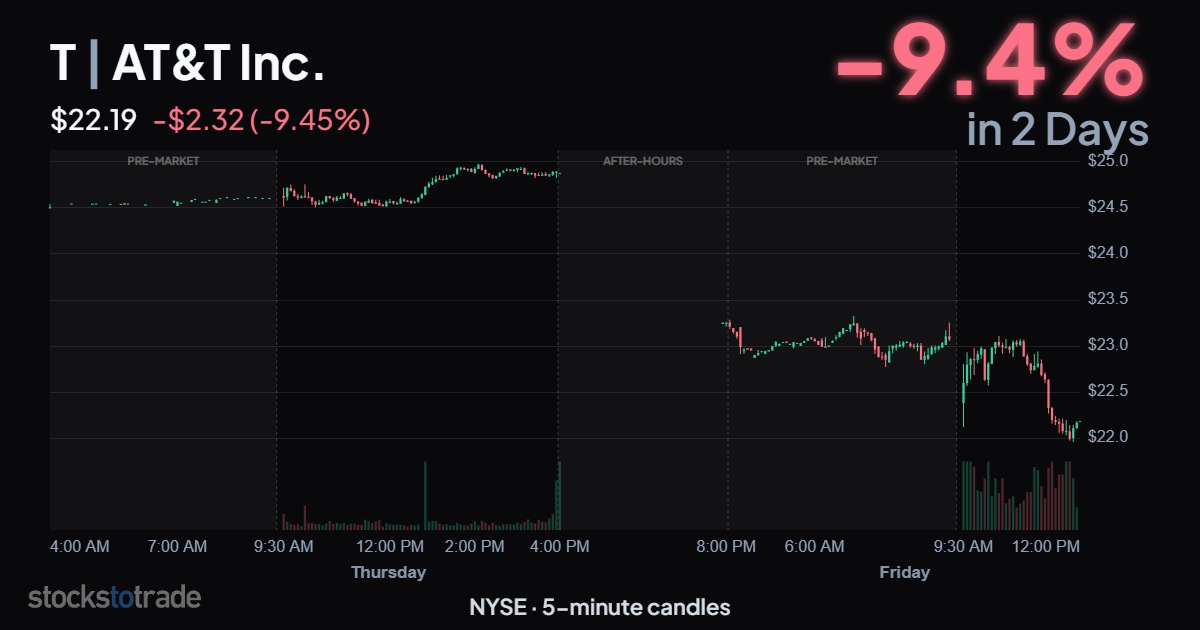
T 10/8-9/26, 5-min candles, market reaction to Starlink news
And T-Mobile US, Inc. (NASDAQ: TMUS) looked like it got sucker-punched…
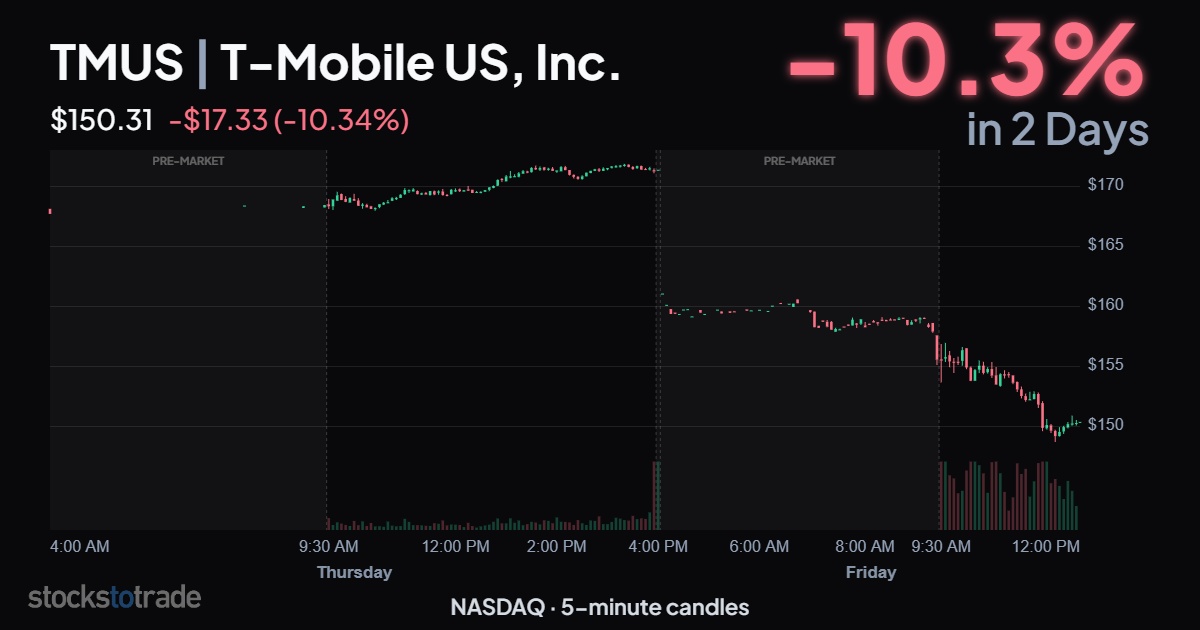
TMUS 10/8-9/26, 5-min candles, market reaction to Starlink news
Who cares, right? They’re dinosaurs anyway.
But this news goes deeper, because while the phone in your pocket is the obvious customer…
The Real Opportunity Got Buried by the Headline
Once you’re through the wall, the phone is not the only thing in the building.
Think about it…
- Factories already use 800MHz frequencies for mission-critical industrial applications
- Drones (both commercial and defense) will no longer have to rely on “line-of-sight” for control and tracking
- Robotic sensors that don’t rely on high-speed connections can be monitored remotely
- Plus, a whole host of other applications
So, machines that never got a clean connection unless somebody bolted a dish on the roof will be able to connect.
Now, to be clear, that 14 MHz of paired spectrum is a coverage layer, not a Netflix pipe, okay?
But a robot on a factory floor doesn’t need a Netflix pipe. It needs a signal that shows up inside the building.
My Take
I think phones are a big story for SpaceX. But the building, robotics, drones, sensors, and other mission-critical industrial applications are the huge story.
My friend, this is an example of how I look at news that drives the markets. Always remember that there’s news behind the news.
Once you begin to connect the dots, trading is more than just the day’s biggest percent gainer. That’s often where you find the best opportunities.
Watchlist
On October 1, Veea Inc. (NASDAQ: VEEA) spiked on contract news with TROLLEE to deploy VeeaONE solutions across 1,000 unattended stores. By last Tuesday (Oct. 6), it looked dead.
On Friday (Oct. 9) VEEA gapped up and ran into the open…
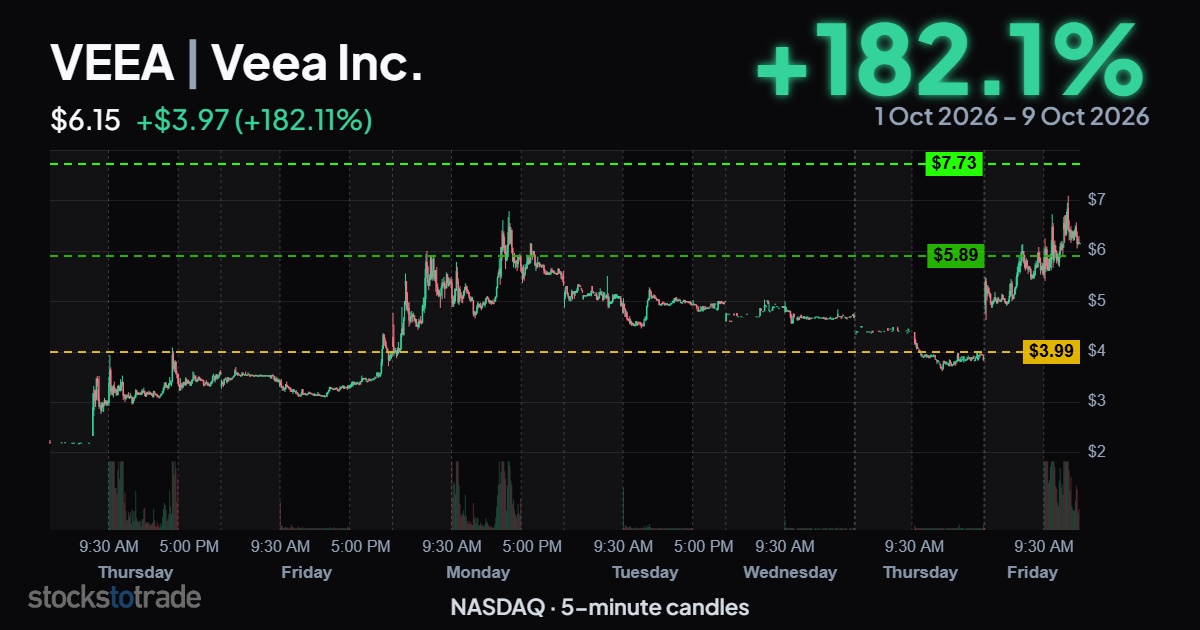
VEEA 10/1-9/26, 5-min candles, multiday runner
After hitting the Oracle signal at $5.89, it pulled back and consolidated. If the Oracle signal acts as support, I like breaks of M/R at $7.73. You could also look for breaks over Friday’s high (“Money Monaco” style). Remember, make a plan, trade the plan.
On My Radar
- Delta Air Line, Inc. (NYSE: DAL) CEO Ed Bastion says “no tit for tat” but still won’t switch to Starlink (yeesh!)
- Is this [R]aging bull market one for the ages?
- Robotics isn’t easy, but Walmart is making progress
- Tim Sykes on one tiny drone company: “one of the strangest and potentially most lucrative transformations I’ve seen in years.”