Vicor Corporation stocks have been trading up by 11.63 percent after upbeat analyst coverage signaled stronger future growth potential.
Click Here for a Millionaire's POV on Trading VICR
SUBSCRIBE FOR ALERTSJOIN 50,000+ ACTIVE TRADERS
Key Takeaways
- Q3 2026 revenue jumped to $197.1M, up 37.5% sequentially and 78.5% year over year, with gross margin lifting to 68.3% and net income more than doubling.
- Management raised Q3 sequential revenue growth guidance twice to more than 30%, fueled by stronger-than-expected royalties from its first non-exclusive VPD license with an AI OEM.
- The company is buying two more sites near its ChiP Fab-1 to enable roughly 5x capacity expansion as VICR chases a swelling order backlog.
- Vicor is monetizing its Vertical Power Delivery IP through licenses and royalties, backed by a USITC patent case that pressures OEMs and hyperscalers to license rather than risk import bans.
- Needham and Roth Capital keep Buy ratings with targets around $350–$360, while debating how much recent royalty upside is one-time versus recurring.
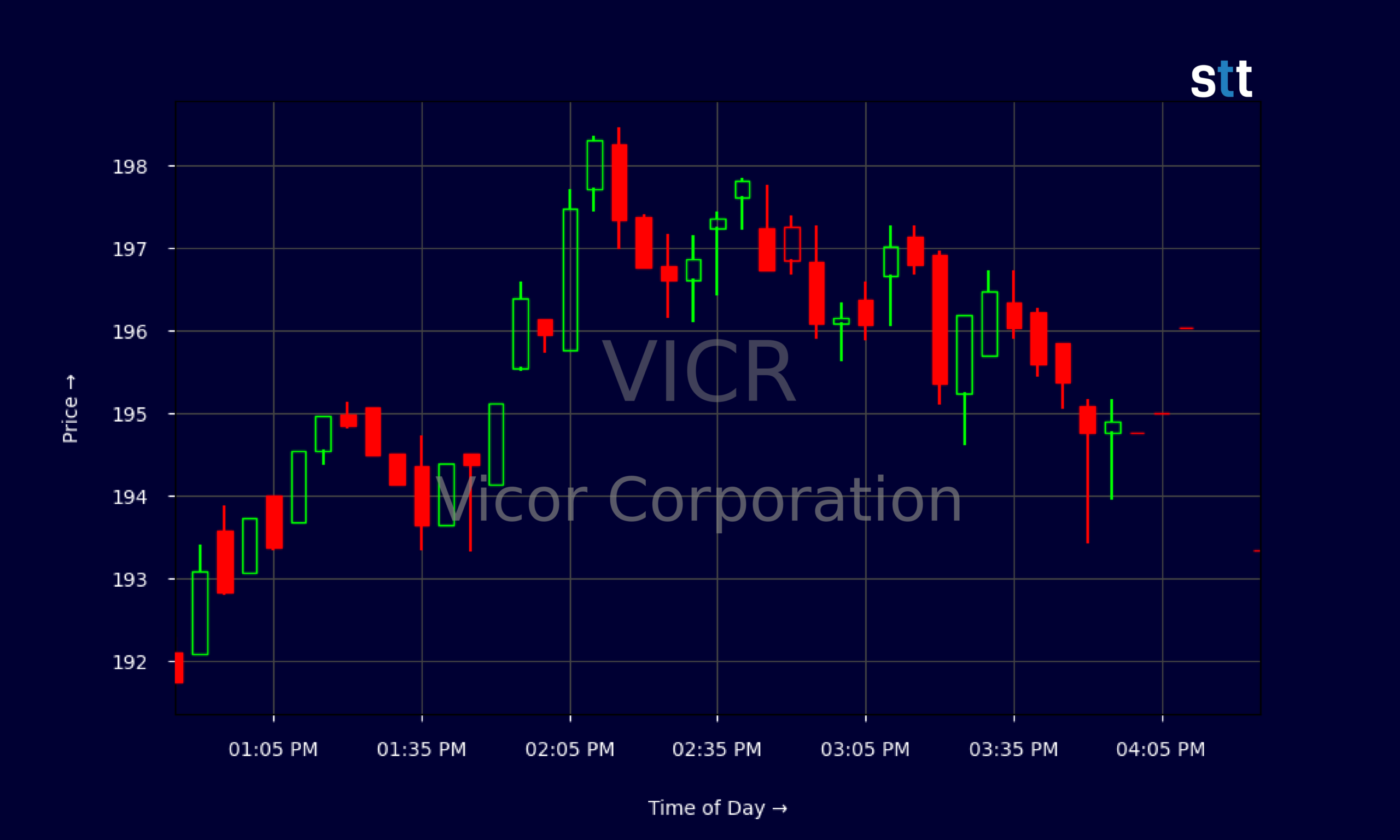
Live Update At 16:47:02 EDT: On Monday, October 26, 2026 Vicor Corporation stock [NASDAQ: VICR] is trending up by 11.63%! Discover the key drivers behind this movement as well as our expert analysis in the detailed breakdown below.
Quick Financial Overview
For traders watching VICR, the numbers behind Vicor Corporation right now look like a textbook high-momentum growth setup, paired with a volatile chart. Q3 2026 revenue came in at $197.1M, a jump of 37.5% versus the prior quarter and 78.5% versus a year earlier. That is hyper-growth territory. At the same time, gross margin expanded to 68.3%, showing that this is not just a volume story; Vicor is scaling a high-value product and royalty mix.
On the bottom line, Q3 EPS of $1.33 more than doubled from last year’s $0.63, even though it landed a touch below the $1.37 consensus. That small miss matters to short-term traders because VICR already trades at a rich valuation. The trailing price-to-earnings ratio near 85 and price-to-sales around 25.9 signal that traders are paying up for future AI-driven growth, not today’s earnings alone.
The balance sheet is clean. Total debt to equity is basically negligible at 0.01, while the current ratio around 13.3 and quick ratio of 10.5 give Vicor plenty of liquidity to fund expansion. Operating cash flow last quarter was about $34.1M, with free cash flow around $23M despite over $11M in capital spending.
More Breaking News
- TSEM Stock Gains Focus As Semtech Expands AI Chip Deal
- CTVA Stock Collapses As Vylor Spinoff And Dividend Cut Shock Market
- ORKA Stock Grinds Higher As Cash War Chest Draws Trader Focus
- Balchem Falls 3% After Analyst Cuts Target
On the chart, VICR has pulled back sharply from above $330 on 2026/10/01 to around $194.77 on 2026/10/26. Recent daily candles show big intraday ranges—like the slide from $307.89 open to $299.29 close on 2026/10/06—telling traders this has become a battleground name. Intraday on 2026/10/26, VICR spent most of the session grinding higher from the low $180s to close near the highs, a sign of dip buying after heavy selling. For active traders, this blend of strong fundamentals and wild swings sets up both breakout and fade opportunities—if you respect risk.
Why Traders Are Watching VICR Now
Vicor Corporation has quietly become a high-conviction AI power play, and traders are starting to treat VICR more like a hot semiconductor momentum name than a sleepy power-module stock. The core driver is its Vertical Power Delivery technology, which routes power more efficiently into advanced compute systems. In Q3 2026, that story finally showed up in the numbers.
VICR not only posted $197.1M in revenue with 68.3% gross margin, it also signaled that this pace is not a one-off. Management raised sequential revenue growth guidance twice in the quarter, from more than 20% to more than 30%, mostly on the back of higher-than-expected royalties from its first non-exclusive VPD license tied to an AI OEM. Those royalties are high-margin, and they explain why net income more than doubled versus a year ago while operating cash flow stayed strong.
At the same time, Vicor is swinging big on capacity. The company bought two additional sites beside its ChiP Fab-1 to support a roughly 5x boost in manufacturing capacity. For traders, that is a clear tell: management believes demand and backlog justify building out serious supply.
There is also a legal kicker supporting VICR’s royalty engine. The USITC opened an investigation into VPD modules and computing systems that allegedly infringe a Vicor patent. The company is asking for a Limited Exclusion Order and cease-and-desist orders, which would block imports of infringing systems. If that process tilts in Vicor’s favor, OEMs and hyperscalers that rely on those modules may have little choice but to take VPD licenses from Vicor, potentially at rising royalty rates as the case progresses.
Analysts are reacting to all of this. Needham lifted its price target on VICR to $350 from $320 and kept a Buy rating after the second guidance hike, citing the non-exclusive VPD royalty deal and AI exposure. Roth Capital also kept Vicor at Buy, with a $360 target, even after trimming from $375 once it reviewed Q3 and the new Q4 guide. Both firms like the stronger royalties and margins but are watching how much of the recent royalty surge is one-time “catch-up” versus a clean recurring run-rate.
Traders should also note the volatility around VICR. On 2026/10/15, shares dropped 13.3% intraday to $212.76 without a clear news catalyst—classic sign of positioning unwinds or crowded sentiment. Insider activity adds a wrinkle: CEO Patrizio Vinciarelli sold 20,000 shares for about $6.3M at roughly $297.89, though he still holds around 8.5M shares. Another insider, Philip D. Davies, sold about 3,072 shares for roughly $972,000 on 2026/10/01. These are modest trims relative to total holdings, but in a stretched, high-PE name, traders often use insider sales as excuses to hit bids.
Put it together and VICR sits at the crossroads of powerful fundamentals—AI-driven revenue growth, 60%+ gross margins, a clean balance sheet—and sharp technical moves. That combination explains why day traders and swing traders on platforms like StocksToTrade keep Vicor on their screens.
Conclusion
VICR is no longer just a niche power-module supplier; Vicor Corporation is acting like an IP-rich AI infrastructure play with a license and royalty kicker. Q3 2026 showed what happens when that story turns real: revenue up 78.5% year over year, margins pushing into the high-60s, net income more than doubling, and a capacity plan aimed at roughly 5x output. Add in the USITC VPD patent case and an aggressive licensing push, and the company is trying to lock down a tollbooth position around advanced compute power delivery.
But traders cannot ignore the flip side. The stock has been a rollercoaster, with VICR ripping to the low $300s after guidance hikes, then sliding hard into the high $100s even as fundamentals improved. A small EPS miss versus consensus, lowered Q4 product-revenue expectations flagged by Roth, insider sales, and debates about one-time versus recurring royalties all feed into that volatility.
For active traders, that volatility is not a bug, it is the feature. Strong trends backed by real numbers, plus sharp air pockets like the 13.3% drop to $212.76 without news, create textbook trading setups—for those who study the patterns and manage risk. As Tim Sykes likes to remind his community, “The market doesn’t care about your opinion, only your discipline—cut losses quickly, protect your capital, and let the best setups come to you.” That dovetails with a more tactical trading mindset: As Tim Bohen, lead trainer with StocksToTrade says, “I focus on momentum that’s visible right now. Speculation on future moves is outside my playbook.” VICR’s current phase fits that mindset perfectly. This analysis is for educational and research purposes only and should not be taken as investment advice.
This is stock news, not investment advice. StocksToTrade News delivers real-time stock market updates tailored to highlight the key catalysts driving short-term price movements. Our coverage is designed for active traders and investors who thrive in fast-moving markets, with a focus on volatile sectors like penny stocks, AI stocks, Robinhood stocks and other momentum plays. From earnings reports and FDA approvals to mergers, new contracts, and unusual trading volume, we break down the events that can spark significant price action.
Looking to level up your trading game? Explore StocksToTrade, the ultimate platform for traders. With powerful tools designed for swing and day trading, integrated news scanning, and even social media monitoring, StocksToTrade keeps you one step ahead.
Check out our quick startup guide for new traders!
- How to Read Stock Charts: A Guide for Beginners
- Trading Plan: 6 Steps to Create One
- How To Create a Stock Watchlist
Ready to build your watchlists? Check out these curated lists:
Once your watchlist is set, take the next step and trade with confidence using StocksToTrade’s robust platform. Don’t miss out — grab your 14-day trial for just $7 and experience the edge you need to thrive in today’s fast-paced markets.