
Rocket Companies Inc. stocks have been trading up by 5.05 percent amid heightened investor optimism over strengthening mortgage demand.
Click Here for a Millionaire's POV on Trading RKT
SUBSCRIBE FOR ALERTSJOIN 50,000+ ACTIVE TRADERS
Key Takeaways Traders Should Watch
- Rocket Mortgage is shifting eligible loans to VantageScore 4.0 after testing showed more approvals, better pricing for many borrowers, and lower internal scoring costs.
- Analysts highlight 30‑year mortgage rates near 6.95% as a major drag on volumes but still rate Rocket Companies (RKT) positively thanks to its servicing-heavy model.
- Multiple firms, including Barclays, Morgan Stanley, Keefe Bruyette and StoneX, cut RKT price targets into the $15–$17 range while keeping Overweight, Outperform or Buy ratings.
- Redfin, now under Rocket Companies, shows the strongest buyer’s market on record, with roughly 63% more sellers than buyers and 21% of listings cutting prices in late September.
- Fresh Redfin analytics suggest U.S. housing affordability could revert to 2018 levels within 2–10+ years if rates, prices and incomes move modestly in the right direction.
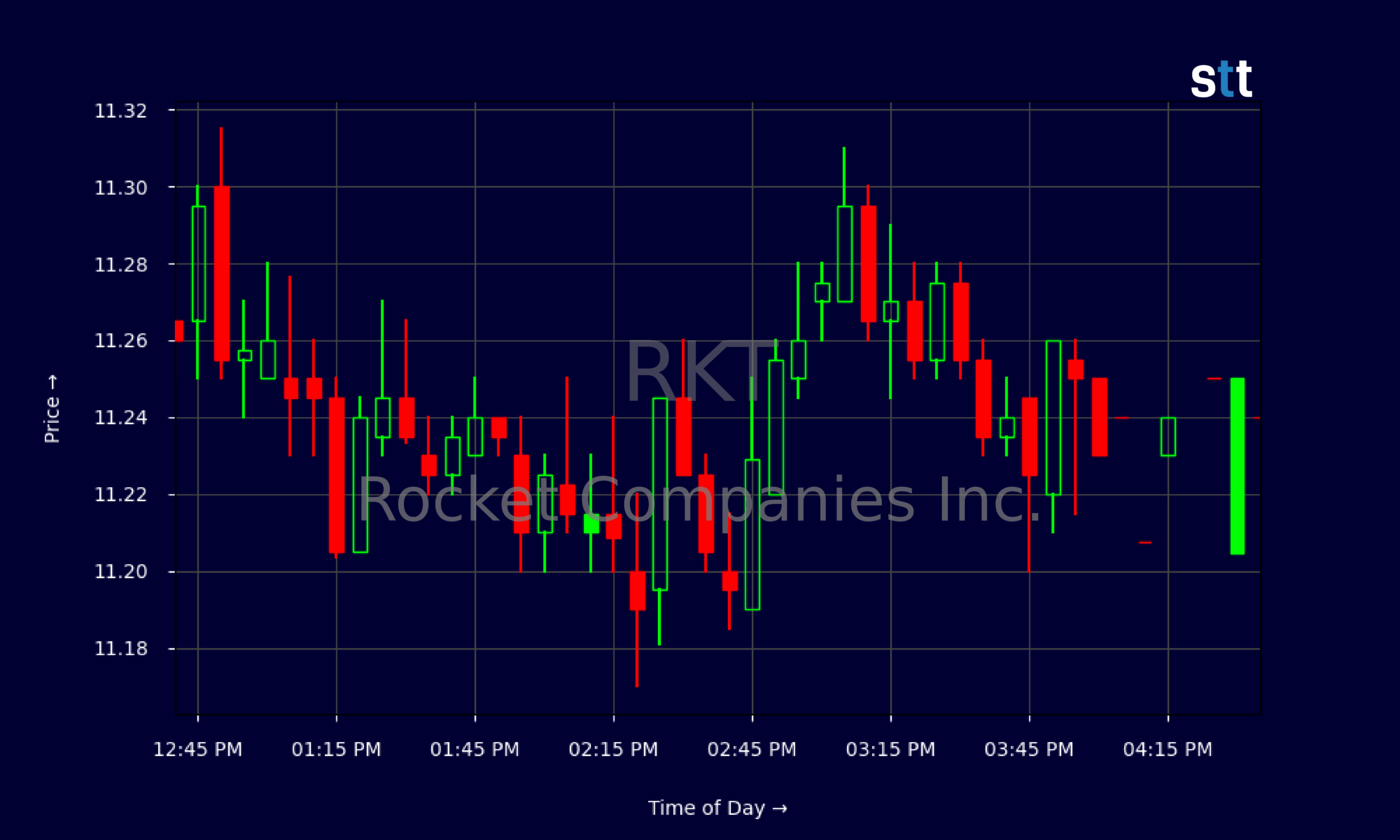
Live Update At 16:49:31 EDT: On Tuesday, October 20, 2026 Rocket Companies Inc. stock [NYSE: RKT] is trending up by 5.05%! Discover the key drivers behind this movement as well as our expert analysis in the detailed breakdown below.
Quick Financial Overview
RKT has been grinding rather than exploding. Over the last few weeks, Rocket Companies shares have mostly held between about $10.5 and $12, closing at $11.25 most recently. That is a modest bounce off the early-October dip near $10.53 but still below the early-month high at $12.66. For short-term traders, RKT is acting like a range‑bound name, not a runaway momentum play.
Intraday, the 5‑minute chart shows tight trading between roughly $11.18 and $11.31 for most of the afternoon. That kind of narrow band says algo-dominated order flow and balanced supply and demand. Breaks above $11.50 or back below $11.00 are the levels many active traders will watch for the next directional push.
Fundamentally, Rocket Companies is still a real earnings story. Quarterly revenue sits around $2.41B, with net income near $230M and a profit margin a bit above 5%. But RKT trades at a rich price/earnings ratio near 52 and a price/sales multiple around 3.6. That combination — thin margins and premium valuation — tells traders the Street is paying for a housing recovery and for the RKT platform, not today’s earnings alone.
More Breaking News
- SKHY Stock Slides As CXMT DRAM Claims Rattle Chip Traders
- NU Stock Jumps As JPMorgan Hikes Nubank Price Target
- RXRX Stock Pops As Sanofi Deal, ARK Buying Ignite Momentum
- WIT Stock Climbs As Traders Weigh Mixed Earnings, Visa Risk
Leverage is meaningful, with total debt to equity above 1.1 and long‑term debt over $27B against roughly $23.5B of equity. Return on equity, just above 3%, is not high, so RKT still needs operating leverage from higher volumes to justify its multiple. In plain terms: the chart shows a coiled spring, while the fundamentals say Rocket Companies must grow into its stock price.
Why Traders Are Watching RKT Right Now
The core reason RKT is on so many watchlists is not just the chart. It is the strategic move by Rocket Mortgage to make VantageScore 4.0 its preferred credit scoring model for eligible loans sold to Fannie Mae, Freddie Mac and the VA. According to Rocket Companies, internal testing showed more clients getting approved, many receiving better pricing, and lower scoring costs for the platform itself.
For traders, that reads like a calculated attempt by RKT to grab volume and protect margins while mortgage rates stay elevated. Importantly, Rocket Mortgage is not abandoning FICO across the board. Higher‑risk or non‑conforming products will still use FICO. That split suggests discipline in underwriting rather than a blind reach for risky business, a nuance short‑term traders should factor into any headline-driven trade.
At the same time, macro headwinds are real. Keefe Bruyette flags 30‑year mortgage rates around 6.95% as a direct hit to purchase and refi volumes. Barclays, Morgan Stanley, Keefe Bruyette, and StoneX have all cut their Rocket Companies price targets — generally from the high‑teens down into the $15–$17 band — yet every one of them kept a positive rating (Overweight, Outperform or Buy). That is classic “cautious bull” territory.
RKT also now controls Redfin, and that changes the data picture. Redfin data show roughly 63% more sellers than buyers — the strongest buyer’s market since at least 2013 — and 21% of sellers cutting asking prices in late September with mortgage rates above 7%. For Rocket Companies, that means fewer casual shoppers but very high leverage to serious, qualified borrowers searching online. Traders should see this as a setup where RKT’s integrated mortgage-plus-brokerage model can quietly gain share, even as absolute transaction volumes stay muted.
Redfin’s affordability modeling adds a longer‑term layer. It outlines paths where U.S. housing costs can drift back toward 2018-style affordability over 2–10+ years if mortgage rates ease a bit, home prices flatten, and incomes keep climbing. If that arc plays out, demand for mortgages — and RKT’s operating leverage — can ramp hard.
Conclusion
Putting it all together, Rocket Companies sits at an interesting crossroads. On one side, the tape shows RKT consolidating between $10 and $12, with clean, tradeable intraday ranges and clear breakout levels. On the other side, the fundamentals show a company in a tough macro lane that is still finding ways to grow approvals, manage pricing, and leverage data through Redfin and VantageScore 4.0.
The analyst backdrop lines up with that “grind higher” story. Price targets are drifting down, not collapsing, while positive ratings remain in place. That tells traders the Street still buys the Rocket Companies model but is resetting expectations for how fast the housing cycle normalizes. For active traders, those kinds of recalibrations often create tradable swings around earnings, guidance updates, and macro rate headlines.
Most important, RKT rewards preparation over prediction. You have a stock with high sensitivity to mortgage rates, headline‑friendly product moves, and a valuation that assumes better days ahead. As Tim Sykes likes to remind traders, “The market doesn’t owe you anything — but if you show up prepared, with a plan and strict risk rules, you give yourself a real shot.” That mindset lines up directly with the discipline needed to work a name like RKT day in and day out. As Tim Bohen, lead trainer with StocksToTrade says, “A consistent trading routine beats sporadic action every time. Show up daily, and you’ll start to see the patterns others miss.”. Rocket Companies will keep throwing catalysts at the tape. Your job is to study the patterns, respect the risk, and trade the setup — not the hype.
This is stock news, not investment advice. StocksToTrade News delivers real-time stock market updates tailored to highlight the key catalysts driving short-term price movements. Our coverage is designed for active traders and investors who thrive in fast-moving markets, with a focus on volatile sectors like penny stocks, AI stocks, Robinhood stocks and other momentum plays. From earnings reports and FDA approvals to mergers, new contracts, and unusual trading volume, we break down the events that can spark significant price action.
Looking to level up your trading game? Explore StocksToTrade, the ultimate platform for traders. With powerful tools designed for swing and day trading, integrated news scanning, and even social media monitoring, StocksToTrade keeps you one step ahead.
Check out our quick startup guide for new traders!
- How to Read Stock Charts: A Guide for Beginners
- Trading Plan: 6 Steps to Create One
- How To Create a Stock Watchlist
Ready to build your watchlists? Check out these curated lists:
Once your watchlist is set, take the next step and trade with confidence using StocksToTrade’s robust platform. Don’t miss out — grab your 14-day trial for just $7 and experience the edge you need to thrive in today’s fast-paced markets.