
Intel Corporation stocks have been trading down by -2.18 percent amid concerns over slowing data center chip demand and margins.
Key Takeaways Traders Must Watch
- Q4 2026 revenue guidance of $15–$16B landed over $1B below the roughly $17B Street consensus, blamed on weak PC demand, supply constraints, and manufacturing bottlenecks.
- The miss on guidance and soft Q3 2026 numbers sparked a roughly 24.8%–25% premarket slide in INTC and a wave of shareholder-rights and securities investigations.
- Levi & Korsinsky is probing whether Intel properly flagged PC softness and manufacturing risks after earlier stressing “strong and sustainable” AI-driven demand.
- Multiple brokers slashed INTC price targets while staying Neutral/Hold, citing deteriorating PC trends, margin pressure, and questions around valuation.
- Cantor Fitzgerald warned that severe memory, wafer, and substrate constraints may cap earnings until at least 2H 2027, even with AI server and foundry growth potential.
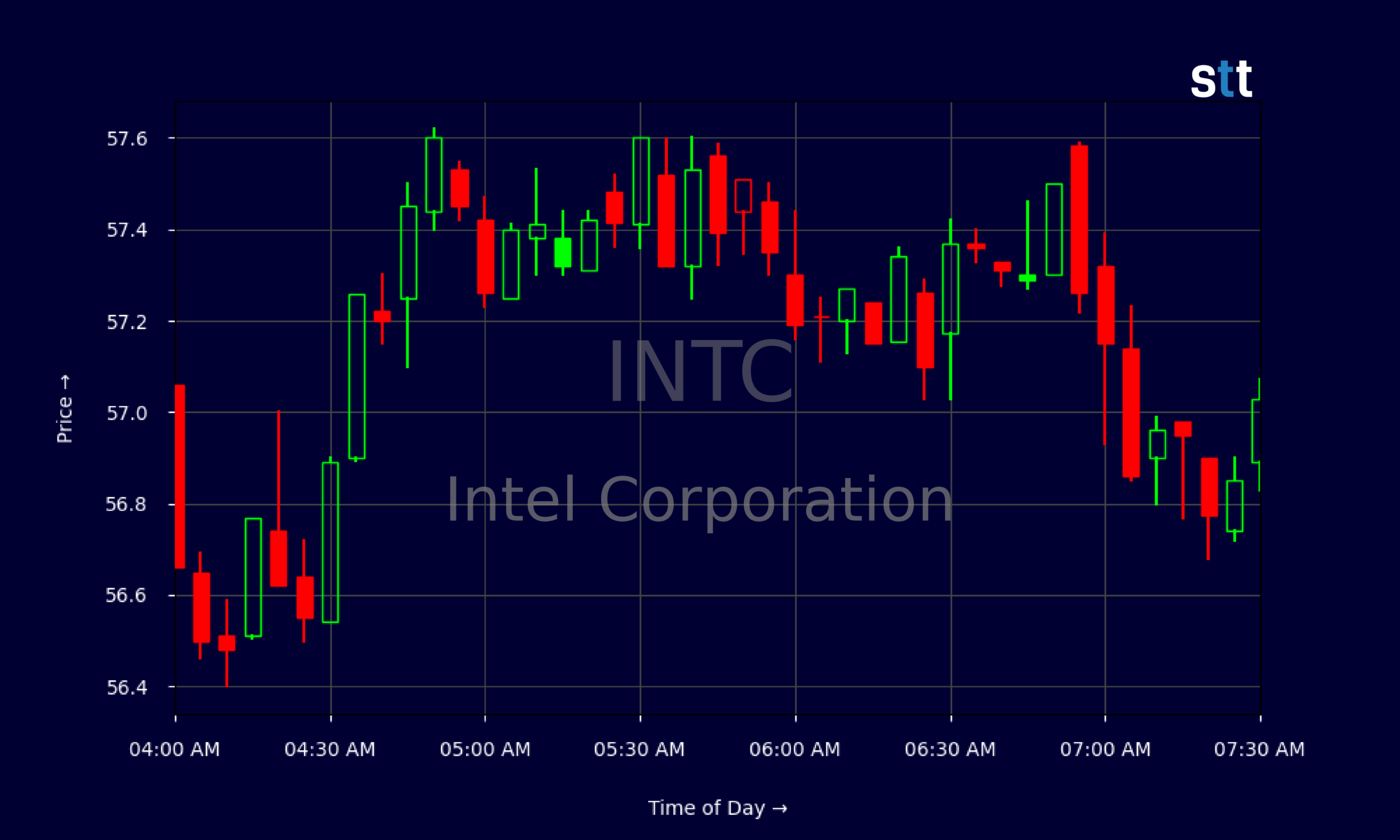
Live Update At 07:34:11 EST: On Thursday, November 05, 2026 Intel Corporation stock [NASDAQ: INTC] is trending down by -2.18%! Discover the key drivers behind this movement as well as our expert analysis in the detailed breakdown below.
Quick Financial Overview
For active traders, INTC has turned from AI darling to cautionary tale in a matter of sessions. The daily chart shows Intel Corporation collapsing from the mid‑$90s on 2026/10/28 to the high‑$50s by 2026/11/04, a drawdown of roughly 35% in days. That kind of vertical drop tells you one thing: funds are bailing, not trimming.
INTC did post Q3 2026 revenue of about $16.5B with gross margin near 38.6%, plus positive operating income of $2.52B and net income of $3.32B. Operating cash flow was a solid $5.08B, with free cash flow of $1.06B. On paper, that doesn’t look like a broken company.
But the ratios tell a different story. Return on equity is negative, profit margins are deeply in the red over the last twelve months, and price‑to‑sales near 9.7 looks rich for a name that just slashed guidance. INTC’s strong balance sheet — $54.0B in cash and short‑term investments and a current ratio of 1.6 — gives it runway, but not a free pass. For traders, this is a broken trend in a still‑healthy business, which often means more volatility before any real base forms.
More Breaking News
- SOFI Stock Extends Rally As Earnings Beat Fuels Big Upgrades
- AEHL Stock Pulls Back As Volatility Grips Low-Float Name
- EOSE Stock Under Pressure As Legal Probes Mount
- EWTX Stock Pops As Cash Surges And Phase 3 Nears
Intraday, the 5‑minute tape around $56–$57 shows tight, choppy action — classic post‑gap digestion, not yet a clean reversal. Short‑term, INTC remains a trading vehicle, not a comfortable hold.
Why Traders Are Watching INTC’s Selloff
The core driver of the INTC slide is guidance. Intel Corporation told the market to expect Q4 2026 revenue of $15–$16B, more than $1B shy of the roughly $17B Wall Street wanted. Management blamed persistent PC‑market weakness, supply constraints, and manufacturing bottlenecks. For a stock priced as a comeback and AI‑foundry story, that kind of reset hits the multiple hard.
Traders reacted fast. INTC cratered roughly 25% premarket after the report, then extended losses as the day wore on. When a mega‑cap name loses more than a quarter of its value in hours, that’s forced selling, margin calls, and systematic de‑risking — exactly the kind of panic short‑biased day traders in the Sykes world look for.
The legal overhang makes it worse. Shareholder‑rights firms — including Levi & Korsinsky — are investigating whether Intel properly disclosed risks around PC demand and manufacturing bottlenecks, given prior commentary headlining “strong and sustainable” AI‑driven demand. That mismatch between the AI story and the PC reality is now center stage, and every new headline can move INTC another 5%–10% intraday.
Sell‑side reactions confirm the damage. DA Davidson cut its INTC target from $100 to $70, still Neutral, saying Foundry and Data Center looked decent but Client Computing was a major drag. Jefferies trimmed from $120 to $85, calling it a “substantial reset” for the December quarter as client revenue weakens and gross margins compress with PC customers working down inventory. Susquehanna slashed from $105 to $75 after Intel guided Q4 about $1.5B below expectations, again pointing squarely at the PC slump.
Layer on Cantor Fitzgerald’s cut from $125 to $90 and warnings about severe memory, wafer, and substrate constraints — with management only talking about real recovery in 2H 2027 — and traders see the problem. This isn’t just one bad quarter. For now, INTC is a show‑me story, with the tape in control.
Conclusion
For traders, INTC has become a live case study in how fast sentiment can flip when narrative and numbers diverge. Intel Corporation spent much of 2026 highlighting AI, data centers, and foundry wins. But when Q3 2026 arrived with weaker Client Computing revenue and a Q4 guide of $15–$16B — well below the roughly $17B consensus — the old PC‑cyclical side of the business yanked the wheel.
Legal probes from Levi & Korsinsky and other firms add another layer. They are asking whether Intel’s earlier communications about “strong and sustainable” AI demand properly balanced the growing PC and manufacturing risks. Whether or not anything comes of these actions, the headline risk alone keeps volatility in INTC elevated and makes clean swing setups harder.
At the same time, INTC is not a penny stock on life support. The company still generates billions in cash, holds over $50B in cash and equivalents, and has meaningful assets across fabs and foundry. That’s why most big brokers — DA Davidson, Cantor, Jefferies, Susquehanna, Morgan Stanley, Truist — cut price targets but stayed around Neutral or Hold. They see pressure, not a collapse.
Traders in the Sykes community know how to treat this type of chart. Big gap down, heavy volume, legal noise, and a complex fundamental story usually means short‑term trading, not blind dip‑buying. As Tim Sykes likes to remind students, “Volatility is your friend, but only if you respect it and cut losses quickly.” That aligns closely with a core rule many active traders follow. As Tim Bohen, lead trainer with StocksToTrade says, “I never chase price. The best opportunities allow me to enter on my terms, not when I’m feeling pressured.” INTC now lives firmly in that high‑volatility bucket — a stock to study carefully, trade with a plan, and never confuse with a sure thing.
This is stock news, not investment advice. StocksToTrade News delivers real-time stock market updates tailored to highlight the key catalysts driving short-term price movements. Our coverage is designed for active traders and investors who thrive in fast-moving markets, with a focus on volatile sectors like penny stocks, AI stocks, Robinhood stocks and other momentum plays. From earnings reports and FDA approvals to mergers, new contracts, and unusual trading volume, we break down the events that can spark significant price action.
Looking to level up your trading game? Explore StocksToTrade, the ultimate platform for traders. With powerful tools designed for swing and day trading, integrated news scanning, and even social media monitoring, StocksToTrade keeps you one step ahead.
Check out our quick startup guide for new traders!
- How to Read Stock Charts: A Guide for Beginners
- Trading Plan: 6 Steps to Create One
- How To Create a Stock Watchlist
Ready to build your watchlists? Check out these curated lists:
Once your watchlist is set, take the next step and trade with confidence using StocksToTrade’s robust platform. Don’t miss out — grab your 14-day trial for just $7 and experience the edge you need to thrive in today’s fast-paced markets.