

Comcast Corporation Common Stock stocks have been trading up by 3.61 percent after robust broadband subscriber growth boosted investor optimism.
Key Takeaways For CMCSA Traders
- Comcast beat Q3 expectations with adjusted EPS of $1.07 versus $0.99 consensus and revenue of $29.3B, delivered strong free cash flow, and showed strength across wireless, Peacock, and Universal’s film slate.
- Management flagged a Q4 restructuring charge above $1B and significant job cuts as CMCSA reorganizes its cable, broadband, and wireless units ahead of an NBCUniversal spin-off targeted for 2027.
- The board kept a $0.33 quarterly cash dividend payable 2027/01/27, signaling ongoing capital-return discipline even as Comcast Corporation Common Stock embarks on a costly transformation.
- CMCSA is pushing multi‑gig Xfinity and Comcast Business builds across Texas, New Hampshire, Virginia, Indiana, and rural California, adding tens of thousands of new passings to its broadband footprint.
- Citi, TD Cowen, and Goldman Sachs trimmed CMCSA price targets but stayed Buy or Neutral, reflecting confidence in EBITDA and ARPU trends while acknowledging broadband line losses and 2027 uncertainty.
Live Update At 15:04:03 EDT: On Friday, October 30, 2026 Comcast Corporation Common Stock stock [NASDAQ: CMCSA] is trending up by 3.61%! Discover the key drivers behind this movement as well as our expert analysis in the detailed breakdown below.
Quick Financial Overview
On the screen, CMCSA is quietly grinding higher. Over the last few weeks, Comcast Corporation Common Stock has pushed from roughly $20.60 on 2026/10/12 to about $23.07 on 2026/10/30. That’s a solid upside move of around 12% in a choppy tape. The daily chart shows a staircase pattern: higher lows from the $20–$21 zone and steady closes above $22 this week, which short-term traders like to see as confirmation of support.
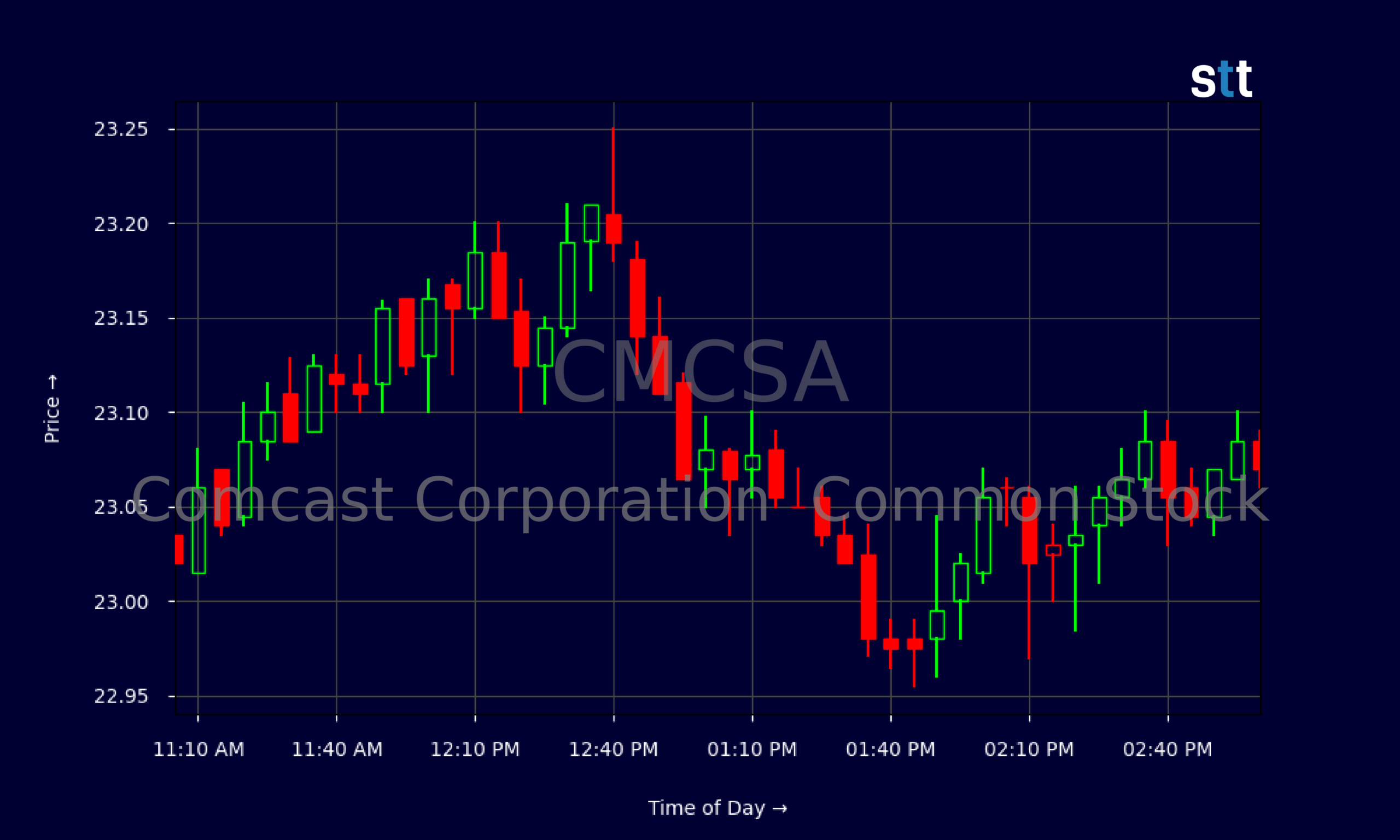
Intraday, CMCSA has been tight but constructive. Today’s 5‑minute candles mostly bounced between $22.95 and $23.20, with buyers defending small dips and pushing a late‑day hold near $23. CMCSA is not a wild low-float runner; it’s a slower name where trend and levels matter more than raw volatility.
More Breaking News
- SNDG ETF Slides As Volatility Pressures Bullish Traders
- MSTR Stock Holds Key Range As Volatility Tightens
- GoDaddy GDDY Jumps As Earnings Beat And AI Airo Shine
- NU Stock Plunges Nearly 20% As Volatility Spikes
Fundamentally, Comcast throws off serious cash. The latest quarter shows revenue around $29.3B and operating cash flow of $7.9B, with free cash flow near $4.2B. Margins are healthy for a mature telecom‑media hybrid: EBITDA margin sits in the high‑20% range and EBIT margin near 15%. CMCSA trades at roughly 6–7x earnings and under 1x sales, with price‑to‑free‑cash‑flow around 3–4x. For traders, that screams “value plus catalyst” rather than momentum growth. The leverage is real, but debt is covered by cash generation and interest coverage near 8x keeps the balance sheet in the “manageable” bucket.
Why Traders Are Watching CMCSA Now
The real action in CMCSA is under the hood, not just on the tape. Comcast Corporation Common Stock just posted a clean Q3 beat: adjusted EPS came in at $1.07 versus $0.99 consensus, on revenue of $29.3B versus $29.22B expected. Free cash flow was strong, wireless and enterprise services kept growing, Peacock booked its second straight profitable quarter, and Universal scored a record global box office. Earnings quality matters, and CMCSA delivered.
Yet the stock is not trading like a carefree growth story, and there’s a reason. Management is reshaping the whole machine. Comcast expects a Q4 restructuring and “transformation” charge north of $1B, plus major job cuts as it reorganizes cable TV, broadband, and wireless ahead of spinning off NBCUniversal and Sky in 2027. For traders, that’s the tug‑of‑war: near‑term EPS drag and execution risk versus the potential payoff of a leaner, pure‑play connectivity CMCSA.
At the same time, Comcast Corporation Common Stock is still returning cash. The board declared a regular $0.33 quarterly dividend, payable 2027/01/27, reinforcing the idea that cash flow is durable enough to fund both restructuring and payouts. Network expansion headlines back that up: Xfinity is adding multi‑gig access for over 16,000 homes and businesses in Willis, Texas, nearly 7,000 new locations in Forest, Virginia, thousands more in Franklin and Barrington, New Hampshire, plus expansions in Indiana and rural Tulare County, California. Each of these builds feeds the core broadband and mobile bundle that underpins CMCSA’s cash machine.
Analysts are signaling “good story, real questions.” Citi cut its CMCSA price target slightly while keeping a Buy, citing uncertainty around those “transformation activities.” TD Cowen trimmed from $39 to $36 but also stayed Buy after solid media EBITDA and softer mobile trends. Goldman nudged its target to $23 and kept Neutral, pointing to better Connectivity & Platforms EBITDA and rising ARPU, but ongoing broadband subscriber losses. In short, the Street sees value in Comcast Corporation Common Stock, but wants proof this restructuring and spin plan actually lands.
Conclusion
For active traders, CMCSA is a big‑cap puzzle worth studying. The chart shows a steady rebound from the low‑$20s, backed by real earnings power and a dividend that management is not touching. Comcast Corporation Common Stock is pricing in both the Q3 beat and the looming hit from more than $1B in restructuring charges. That kind of tension is exactly what creates trading opportunity around earnings, headlines, and key technical levels.
Fundamentally, the story splits in two. On one side, you have profitable content and experiences — Peacock turning the corner, Universal putting up record box office — plus a modern ad tech push through Universal Ads’ new campaign‑management integrations. On the other, you have the grind: broadband competition, line losses, and a multi‑year capex cycle to keep Xfinity and Comcast Business ahead with multi‑gig networks across Texas, New Hampshire, Virginia, Indiana, and California. CMCSA’s value case leans on whether pricing, bundling, and cost cuts outrun those headwinds.
Traders in the Sykes community focus on catalysts and risk control, not stories alone. Tim Sykes likes to remind people, “The market doesn’t care about your opinion, only about price and volume — so trade the trend and cut losses fast.” As Tim Bohen, lead trainer with StocksToTrade says, “I never chase price. The best opportunities allow me to enter on my terms, not when I’m feeling pressured.” With CMCSA, that means respecting key support in the low‑$22s, watching how the stock reacts to any new restructuring or spin‑off headlines, and treating this as an educational case study in how a legacy giant tries to reinvent itself while keeping cash flowing. This article is for educational and research purposes only and is not investment advice.
This is stock news, not investment advice. StocksToTrade News delivers real-time stock market updates tailored to highlight the key catalysts driving short-term price movements. Our coverage is designed for active traders and investors who thrive in fast-moving markets, with a focus on volatile sectors like penny stocks, AI stocks, Robinhood stocks and other momentum plays. From earnings reports and FDA approvals to mergers, new contracts, and unusual trading volume, we break down the events that can spark significant price action.
Looking to level up your trading game? Explore StocksToTrade, the ultimate platform for traders. With powerful tools designed for swing and day trading, integrated news scanning, and even social media monitoring, StocksToTrade keeps you one step ahead.
Check out our quick startup guide for new traders!
- How to Read Stock Charts: A Guide for Beginners
- Trading Plan: 6 Steps to Create One
- How To Create a Stock Watchlist
Ready to build your watchlists? Check out these curated lists:
Once your watchlist is set, take the next step and trade with confidence using StocksToTrade’s robust platform. Don’t miss out — grab your 14-day trial for just $7 and experience the edge you need to thrive in today’s fast-paced markets.