
Comcast Corporation Common Stock faces pressure as intensifying broadband competition weighs on investor sentiment; stocks have been trading down by -3.17 percent.
Click Here for a Millionaire's POV on Trading CMCSA
SUBSCRIBE FOR ALERTSJOIN 50,000+ ACTIVE TRADERS
Key Takeaways
- Wall Street firms are cutting Comcast price targets while keeping neutral ratings, signaling rising disruption risk across CMCSA’s legacy cable and telecom businesses.
- Shares of CMCSA dropped about 2% after SpaceX bought 800 MHz spectrum, sharpening fears around future broadband and mobile competition.
- Oppenheimer now expects much larger broadband subscriber losses for Comcast through 2030, even as Peacock posts a second straight profitable quarter.
- Earnings at CMCSA have slipped year over year, with pressure from tougher comps and stronger rivals in streaming and theme parks.
- Multiple firms, including TD Cowen, Evercore ISI, New Street, and Bernstein, now cluster CMCSA price targets in the upper‑$20s, reflecting muted upside expectations.
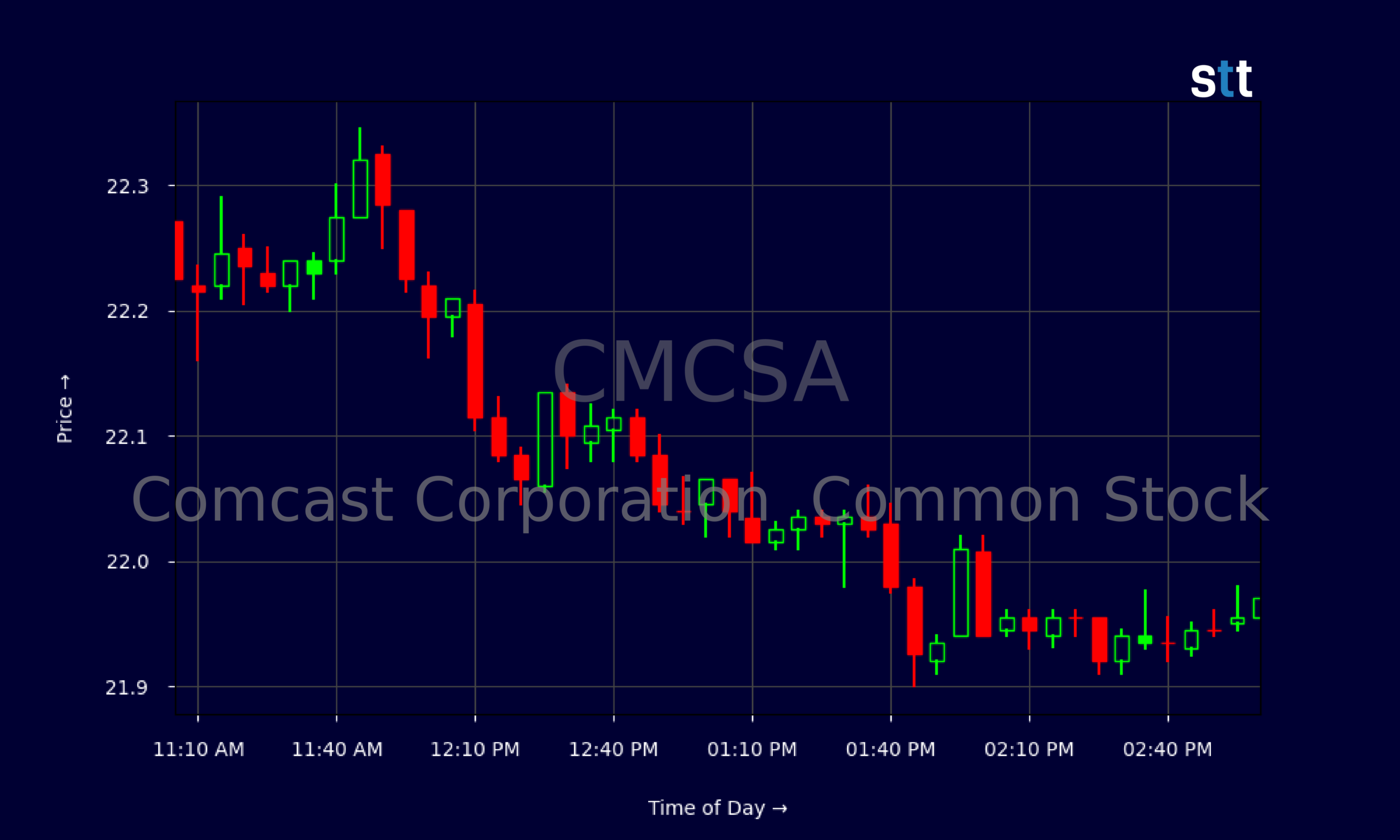
Live Update At 15:02:34 EDT: On Monday, October 26, 2026 Comcast Corporation Common Stock stock [NASDAQ: CMCSA] is trending down by -3.17%! Discover the key drivers behind this movement as well as our expert analysis in the detailed breakdown below.
Quick Financial Overview
CMCSA has been grinding lower, not crashing. Over the past few weeks, Comcast traded in a tight band, mostly between $20.50 and $23.00, with the latest close near $21.97. That’s a controlled downtrend, not panic, but it tells traders money is leaking out, not piling in.
Intraday, CMCSA’s 5‑minute chart shows an early push above $22.40 fading into the afternoon, with steady selling pulling the stock under $22.00 by the close. That pattern—morning strength, afternoon fade—often signals short‑term distributions as larger players sell into pops.
Fundamentally, Comcast still throws off serious cash. Quarterly revenue sits near $29B, with EBITDA around $9.1B and operating cash flow of roughly $7.9B. Free cash flow of about $4.2B backs a rich near‑6% dividend yield. Valuation is compressed: a P/E near 6.6, price‑to‑sales under 0.6, and price‑to‑cash‑flow around 2.3 leave CMCSA looking “cheap” on classic metrics.
More Breaking News
- BORR Stock Under Pressure As Fearnley Cuts Rating To Hold
- CoreWeave (CRWV) Slides As Debt Fears Trump AI Growth
- CoreWeave Stock Slides As Debt Fears And Insider Selling Mount
- DigitalOcean DOCN Stock Whipsaws As AI Bets And Analyst Upgrades Collide
But leverage is real. Total debt is over $83B, and current and quick ratios below 1.0 show a balance sheet built for stability, not hyper‑growth. For traders, that mix—big cash, big debt, low multiple—usually means the market is bracing for slower or more volatile future earnings from Comcast.
Why Traders Are Watching CMCSA Now
The real story around CMCSA right now is not one headline; it’s a drumbeat. Morgan Stanley cut its price target on Comcast from $29 to $27, keeping an Equal Weight rating but warning that AI bill‑cutting tools are training customers to hunt for cheaper wireless and cable options. That’s a structural threat. When algorithms push households off traditional bundles, legacy economics suffer.
Barclays followed, trimming its Comcast target from $26 to $24 with another Equal Weight call. The message to traders is blunt: upside to earnings looks “incremental,” while downside from disruption looks larger. That kind of skew keeps big money cautious and caps how high CMCSA’s multiple can re‑rate on any short‑term bounce.
Competitive pressure is no longer theoretical. When SpaceX announced its deal for 800 MHz low‑band spectrum—enabling nationwide phone coverage—Comcast shares dropped about 2%. Traders didn’t wait to see long‑run numbers; they repriced CMCSA immediately. SpaceX already looms over the broadband landscape with satellite offerings. Add wireless, and Comcast’s core cable and mobile bundles face a tougher future.
Bernstein took that threat seriously, slashing its CMCSA target from $28 to $23 while maintaining Market Perform. The firm cited pressure from SpaceX broadband and wireless, weak seasonal trends, and aggressive pricing across the industry. For active traders, a cut that deep from a major research house is a clear sentiment tell: the Street sees erosion, not expansion, in Comcast’s advantage.
Layer on softness in Comcast’s theme parks—Orlando attendance weakening into Q3 and lagging Disney—and the picture broadens. The parks and experiences arm was supposed to be a growth offset. Instead, it’s another area where CMCSA is trailing a key rival.
Conclusion
Oppenheimer’s latest note on CMCSA captures the tug‑of‑war traders are seeing. The firm reaffirmed a neutral Perform view after a mixed Q3: margins are improving, Peacock just notched its second profitable quarter, and on EV/EBITDA and free cash flow yield Comcast still screens cheap. Yet Oppenheimer also doubled its 2027–2030 broadband net‑loss forecasts and flagged accelerating subscriber declines and falling ARPU. That’s why the stock looks “cheap” and stays cheap.
Across the Street, TD Cowen, Evercore ISI, New Street, and Bernstein all trimmed CMCSA price targets. Most now cluster in the upper‑$20s, with a broad Hold consensus. At the same time, Comcast’s Q2 and Q3 EPS moved lower year over year once the one‑time Hulu bump rolled off, while stronger streaming names like Netflix and Disney grabbed more narrative momentum. Even NBC’s loss of the rotating Emmy telecast to Amazon’s six‑year global streaming deal underscores how legacy TV is losing prestige events.
For traders, CMCSA is a classic Sykes‑style teaching chart: heavy overhang, real fundamental headwinds, and a fat dividend plus low multiple that tempt slower money to “value buy” every dip. That combination can set up clean, short‑term trading edges around earnings, rating changes, or big competitive headlines. As Tim Sykes likes to say, “The market doesn’t care about your opinion, only the price action—respect the trend, trade the pattern, and always cut losses quickly.” In a similar spirit of disciplined trading, As Tim Bohen, lead trainer with StocksToTrade says, “If you’re still guessing at the end of your analysis, it’s probably not a trade worth taking.”. This analysis is for educational and research purposes only and should be used as a starting point for your own CMCSA trading homework, not as investment advice.
This is stock news, not investment advice. StocksToTrade News delivers real-time stock market updates tailored to highlight the key catalysts driving short-term price movements. Our coverage is designed for active traders and investors who thrive in fast-moving markets, with a focus on volatile sectors like penny stocks, AI stocks, Robinhood stocks and other momentum plays. From earnings reports and FDA approvals to mergers, new contracts, and unusual trading volume, we break down the events that can spark significant price action.
Looking to level up your trading game? Explore StocksToTrade, the ultimate platform for traders. With powerful tools designed for swing and day trading, integrated news scanning, and even social media monitoring, StocksToTrade keeps you one step ahead.
Check out our quick startup guide for new traders!
- How to Read Stock Charts: A Guide for Beginners
- Trading Plan: 6 Steps to Create One
- How To Create a Stock Watchlist
Ready to build your watchlists? Check out these curated lists:
Once your watchlist is set, take the next step and trade with confidence using StocksToTrade’s robust platform. Don’t miss out — grab your 14-day trial for just $7 and experience the edge you need to thrive in today’s fast-paced markets.