

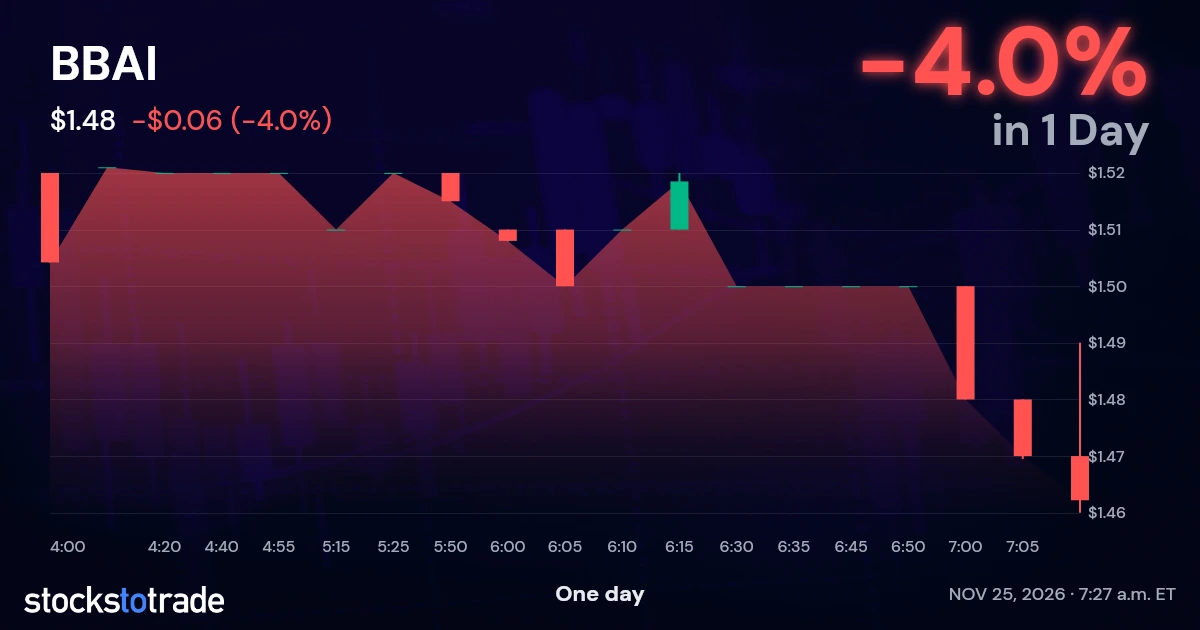
BigBear.ai fell 4% before regular trading as inflation concerns reinforced expectations for higher interest rates and weighed on technology shares.
Why BigBear.ai Fell Before Regular Trading
BigBear.ai closed at $1.54, then fell 4% to $1.48 before regular trading began as inflation concerns drove technology stocks lower. Investors were preparing for PCE, a consumer-price measure watched closely by the Federal Reserve, the central bank, ahead of an expected rate increase.
BigBear.ai Stock And Interest Rates
Stubborn inflation strengthens the case for raising the central bank’s benchmark rate, which shapes borrowing costs. Higher rates make safer investments more rewarding, reducing what investors pay today for distant profits. BigBear.ai’s losses leave its share value tied partly to future profits.
What BigBear.ai Inc. Does
BigBear.ai sells artificial intelligence tools that help defense and intelligence customers analyze information and make decisions. Its decline exceeded that of QQQ, a fund tracking a technology-heavy group of large Nasdaq-listed companies. Its losses help explain that sensitivity, but do not establish why the entire extra decline occurred.
Quick Financial Overview
BigBear.ai has sales but loses money; its $711.9M stock-market value makes it a small-cap, meaning a smaller public company. Its $285.8M in cash, cash equivalents, and short-term investments as of September 30, 2026 includes money on hand and readily sold assets. That covers about ninety months if the latest quarterly operating spending rate stays unchanged.
BigBear.ai Revenue And Net Loss
The latest quarter brought $43.6M in revenue and a net loss of $91.9M. A reduction in the recorded value of acquired businesses contributed substantially to that loss. That accounting charge does not itself consume cash, so the loss should not be read as money spent.
BigBear.ai Operating Cash Use
Running the business consumed $9.6M during the quarter. This measures cash used in daily operations rather than the accounting loss.
BigBear.ai Shares Available For Trading
BigBear.ai has about 477 million shares available for public trading. That share supply does not support an explanation based on very few shares being available.
BigBear.ai Stock Is down 65% Over Six Months
BigBear.ai is down 65% over six months after trading around $4.25, leaving it near its annual low. The longer decline shows that today’s selling extends an existing slide. It recorded a daily move this large as recently as the prior session.
Trading Perspective
The rounded area around $1.50 is the nearby level BigBear.ai needs to rise back above, not a price where previous declines have reliably stopped. Its annual high in the low $7s is a distant reference, not an immediate target. Holding near today’s area would not alone reverse the longer decline.
Trader’s perspective BBAI
3 months, daily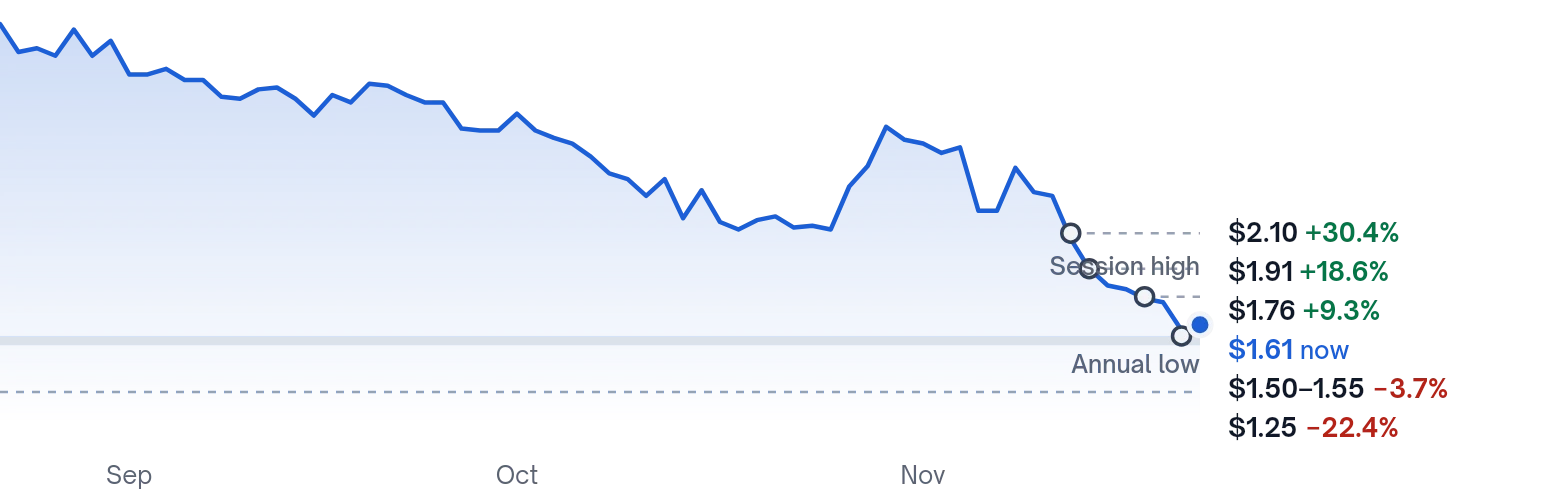
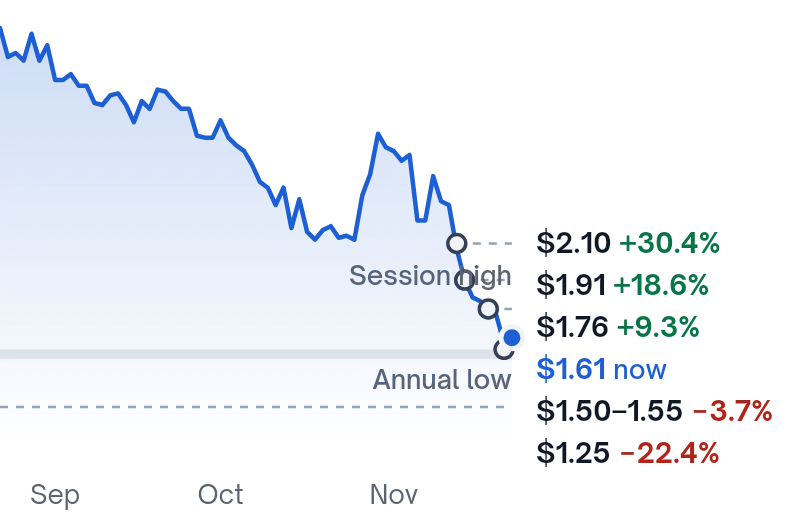
Down 40% since late October and sitting near the annual low. The first question is whether $1.55 holds.
Each dashed line starts where the level formed. Lows below the price are support, where buyers stepped in. Highs above it are resistance, where sellers took over. A level that breaks puts the next one in play.
As of Nov 21, 2026, 9:28 a.m. ET · AI-generated from market data · Not investment advice
BigBear.ai Federal Contract Wins
We last covered BigBear.ai in October when it rose on federal artificial intelligence deals. Winning work and booking sales are separate steps. Government funding and the timing of work affect when those awards become revenue.
Conclusion
The next PCE release is the key event for BigBear.ai. A hotter reading could pressure its share value; a cooler one could ease that pressure without fixing its losses. Its funding covers the wait at the current spending rate.
Where does BBAI go from here?
Tap to vote and see what other traders think.
This is stock news, not investment advice. StocksToTrade News delivers real-time stock market updates tailored to highlight the key catalysts driving short-term price movements. Our coverage is designed for active traders and investors who thrive in fast-moving markets, with a focus on volatile sectors like penny stocks, AI stocks, Robinhood stocks and other momentum plays. From earnings reports and FDA approvals to mergers, new contracts, and unusual trading volume, we break down the events that can spark significant price action.
This article was generated with the support of AI and reviewed by an editor. For more information see our T&C.
Looking to level up your trading game? Check out our quick startup guide for new traders!
- How to Read Stock Charts: A Guide for Beginners
- Trading Plan: 6 Steps to Create One
- How To Create a Stock Watchlist
Ready to build your watchlists? Check out these curated lists: