
AT&T Inc. stocks have been trading up by 3.79 percent on optimism surrounding its 5G expansion and debt-reduction progress.
Click Here for a Millionaire's POV on Trading T
SUBSCRIBE FOR ALERTSJOIN 50,000+ ACTIVE TRADERS
Key Takeaways
- AT&T beat Q3 expectations with adjusted EPS of $0.65 vs. $0.60 and revenue of $32.3B vs. $31.65B, while adding 379,000 postpaid phone lines and keeping churn at 0.92%.
- Management lifted 2026 adjusted EPS guidance to about $2.40 and plans to return more than $45B to shareholders from 2026–2028 while targeting ~2.5x leverage by 2029.
- Q4 free cash flow is guided to roughly $6B, up sharply from $4.2B a year ago, after delivering $5.0B in Q3, supporting AT&T’s balance sheet and cash returns.
- The company is accelerating its move away from copper and leaning on record fiber reach, advanced connectivity growth, and tiered pricing to drive higher‑margin broadband.
- AT&T will sell AT&T Mexico for $2B in cash plus potential extras, refocusing capital on U.S. fiber and 5G while simplifying the business.
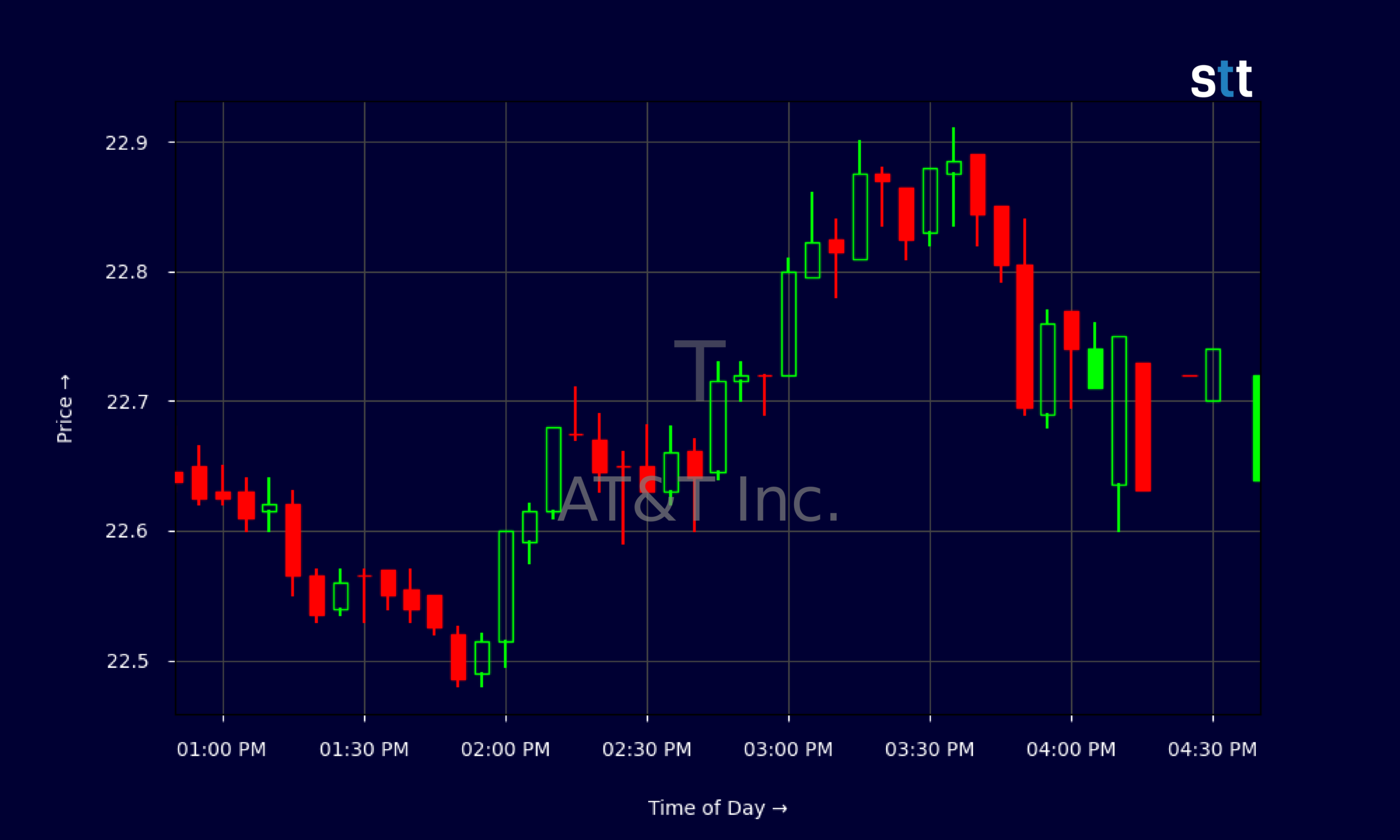
Live Update At 16:48:34 EDT: On Thursday, October 22, 2026 AT&T Inc. stock [NYSE: T] is trending up by 3.79%! Discover the key drivers behind this movement as well as our expert analysis in the detailed breakdown below.
Quick Financial Overview
AT&T Inc. (T) just printed the kind of quarter fundamentals traders like to see, even if the stock is not acting like it. AT&T delivered Q3 adjusted EPS of $0.65 versus $0.60 expected and revenue of $32.3B versus $31.65B, a clean beat on both lines. Service revenue growth was the strongest in more than four years, powered by over 1 million Advanced Connectivity net adds and record fiber and fixed wireless additions.
On the cash side, AT&T generated about $5.0B of free cash flow in Q3 and now guides Q4 free cash flow to roughly $6B, well above last year’s $4.2B. For a high‑debt telecom like T, that cash is the lifeblood for dividends, debt paydown, and any buybacks.
Valuation remains compressed. T trades at a price‑to‑earnings ratio near 7.4 and a price‑to‑sales ratio around 1.2, despite a dividend yield near 5%. Profitability metrics are solid, with EBITDA margin above 40% and EBIT margin above 26%. Balance sheet leverage is still heavy, but interest coverage above 7x gives AT&T some breathing room as it works toward its leverage target.
More Breaking News
- SPCX Slides As SpaceX Faces Geopolitics, Competition, And AI Risk
- Blue Owl Capital Stock Pops As Sale Talk Fuels Rebound
- AT&T Stock Slips As Strong Cash Flows Meet Subscriber Jitters
- NOK Stock Slides As European ADR Weakness Deepens
On the chart, T has pulled back from late‑September levels near $25 to around $22.74, even after the earnings beat. The last two sessions show heavy volatility: a sharp post‑earnings drop from the $23s down toward $22, followed by a bounce. Intraday action on the latest day shows steady grinding higher from the low $22s into the close, with higher lows all afternoon. For short‑term traders, that looks like dip‑buying interest stepping in around $22, but the recent breakdown from the $24–$25 area says overhead resistance remains real.
Why Traders Are Watching AT&T Now
AT&T is in one of those classic trader puzzles: the story is improving, but the stock is trading like the crowd still does not trust it. T’s Q3 report was one of its cleaner prints in years. Adjusted EPS climbed to $0.65 from $0.54 a year ago. Advanced Connectivity operating income jumped nearly 19%. Management raised 2026 adjusted EPS guidance to about $2.40, above both the prior range and Wall Street’s $2.34 consensus.
At the same time, AT&T laid out a powerful capital return story. From 2026–2028, the company plans to return more than $45B to shareholders, backed by strong free cash flow and lower long‑term capital spending. T also reaffirmed its path toward roughly 2.5x leverage by 2029, supported by $4B in targeted annual cost savings by 2028 and the planned $2B cash sale of AT&T Mexico.
Under the hood, the strategic shift is clear. AT&T is pushing hard into fiber and modern broadband, with record fiber net adds and record fixed wireless internet additions. Management says fiber reach is at record levels and spectrum positioning is “stronger than ever.” At the same time, T is accelerating the shutdown of copper‑based legacy services, aiming to exit almost all non‑California copper wire centers by 2029. That move should cut maintenance costs and boost margins long term.
Yet traders are not giving T a free pass. The stock dropped more than 5% after earnings, even with the EPS beat and higher outlook, because postpaid phone net adds of 379,000 came in softer than the market wanted. Add in rising customer acquisition costs, heavier working capital needs, and an intense wireless price war, and you can see why Goldman Sachs cut its AT&T price target from $30 to $27 while keeping a Buy rating.
There is also the Elon Musk factor. Earlier in October, AT&T slumped along with Verizon and T‑Mobile after SpaceX bought low‑band spectrum, sparking fears that satellite‑to‑phone service might one day take share from traditional carriers. Some analysts think Starlink’s threat is limited for now, but the 10–12% sector slide on that headline showed just how jumpy telecom traders are about disruption.
So you have AT&T tightening its operations, lifting long‑term earnings targets, and throwing off more cash, while the market fixates on near‑term subscriber metrics and potential new competition. That disconnect is exactly what active traders hunt: strong fundamentals, weak sentiment, and clear technical levels to trade against.
Conclusion
For active traders, AT&T is turning into a pure scoreboard name. The numbers say one thing; the tape says another. On the scoreboard side, T is doing the work: revenue inflection in Advanced Connectivity, record fiber momentum, higher 2026 EPS guidance, and a clear plan to wring $4B in annual costs out of the system. Q3 free cash flow of $5.0B and a Q4 target of around $6B support AT&T’s dividend and its pledge to return over $45B to shareholders between 2026 and 2028.
Strategically, AT&T is simplifying. The sale of AT&T Mexico for $2B in cash plus potential extras and the accelerated shutdown of copper lines both point to a leaner, more focused U.S. fiber‑and‑5G story. Those moves line up with the long‑term leverage goal and with a capital‑light mindset that Wall Street usually rewards — eventually.
But traders do not trade “eventually.” They trade price and catalysts. Right now, the market is punishing any wobble in wireless growth and reacting aggressively to perceived threats like satellite‑to‑phone services. That is why AT&T shares sank over 5% on an otherwise strong print and why T slid double digits with the rest of the group on the SpaceX spectrum news. As Tim Bohen, lead trainer with StocksToTrade says, “There’s a pattern in everything; you just have to stick around long enough to see it.” In a name like AT&T, where the story and the tape can diverge for long stretches, that mindset can help traders stay focused on how the pattern in price action is actually unfolding rather than how the narrative sounds.
For traders who follow Tim Sykes‑style discipline, the lesson around AT&T is the same as always: “Trade the price action, not the story. Stories change slowly; prices change fast.” AT&T’s story is getting better. Whether that finally pulls the chart higher is something traders will be tracking day by day, one setup at a time.
This is stock news, not investment advice. StocksToTrade News delivers real-time stock market updates tailored to highlight the key catalysts driving short-term price movements. Our coverage is designed for active traders and investors who thrive in fast-moving markets, with a focus on volatile sectors like penny stocks, AI stocks, Robinhood stocks and other momentum plays. From earnings reports and FDA approvals to mergers, new contracts, and unusual trading volume, we break down the events that can spark significant price action.
Looking to level up your trading game? Explore StocksToTrade, the ultimate platform for traders. With powerful tools designed for swing and day trading, integrated news scanning, and even social media monitoring, StocksToTrade keeps you one step ahead.
Check out our quick startup guide for new traders!
- How to Read Stock Charts: A Guide for Beginners
- Trading Plan: 6 Steps to Create One
- How To Create a Stock Watchlist
Ready to build your watchlists? Check out these curated lists:
Once your watchlist is set, take the next step and trade with confidence using StocksToTrade’s robust platform. Don’t miss out — grab your 14-day trial for just $7 and experience the edge you need to thrive in today’s fast-paced markets.