AT&T Inc. stocks have been trading down by -5.55 percent amid concerns over mounting 5G infrastructure costs and debt pressures.
Click Here for a Millionaire's POV on Trading T
SUBSCRIBE FOR ALERTSJOIN 50,000+ ACTIVE TRADERS
Key Takeaways Traders Need To Know
- Shares of AT&T, Verizon, and T-Mobile dropped 10–13% after SpaceX agreed to acquire a nationwide low-band spectrum portfolio, heightening fears of a disruptive Starlink Mobile competitor.
- T-Mobile US fell 13%, and AT&T and Verizon dropped around 10% on worries Starlink Mobile will become a formidable new U.S. mobile carrier with nationwide reach.
- Scotiabank lowered its AT&T price target, warning SpaceX’s spectrum purchase makes its hybrid satellite–terrestrial network a more credible long-term threat that may pressure telecom valuations.
- Bernstein downgraded AT&T from Outperform to Market Perform and trimmed its price target to $24, citing rising Starlink competition, pricing pressure, and seasonal Q4 headwinds.
- AT&T, Verizon, and T-Mobile became the three worst S&P 500 performers after the Starlink Mobile spectrum deal, with AT&T sliding roughly 10% on the news.
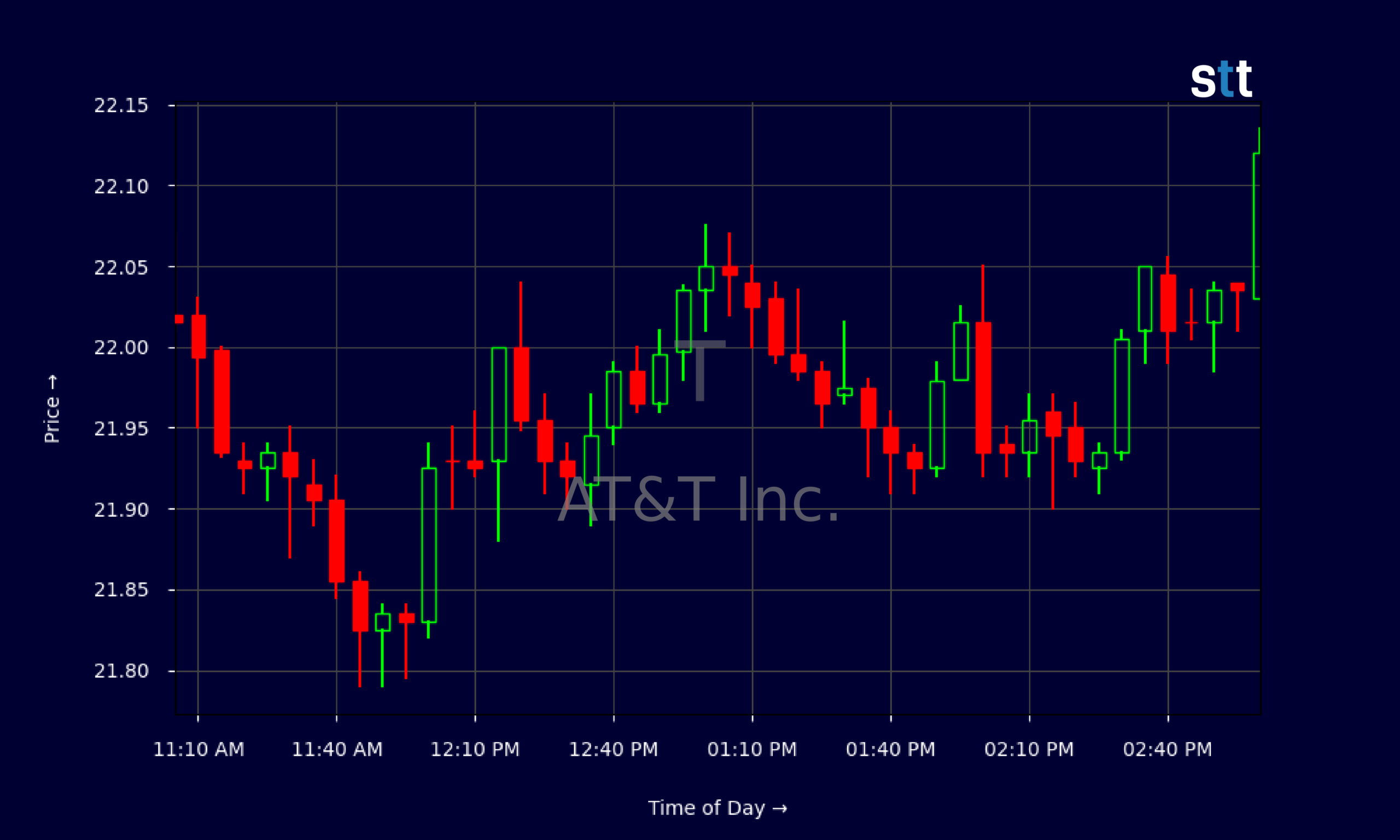
Live Update At 15:04:25 EDT: On Wednesday, October 21, 2026 AT&T Inc. stock [NYSE: T] is trending down by -5.55%! Discover the key drivers behind this movement as well as our expert analysis in the detailed breakdown below.
Quick Financial Overview
AT&T Inc. (T) just went from steady defensive name to front-line battleground. The numbers show why traders are glued to the tape.
Over the past few weeks, T has slipped from the mid-$24s to about $22.12, a drop of roughly 9% as Starlink headlines hit. The daily chart shows a clear breakdown: a tight range near $24–$25 gave way to heavy selling, with multiple red candles clustering after the spectrum news. For active traders, that’s the classic transition from consolidation to distribution.
Intraday, T’s 5‑minute chart on the latest session tells a similar story. After gapping down from around $23.70 in premarket to open near $21.89, AT&T bounced early toward $22.60 but couldn’t hold. Through the day, the stock churned between $21.90 and $22.10, signaling dip buyers are present but not in control.
More Breaking News
- SOFI Stock Draws Bullish Calls As Stablecoin Bet Scales
- SKHY Stock Slides As China DRAM Fears Clash With AI Demand
- SSPC Leverage Shares 2X Short SPCX Daily Draws Active Traders After Sharp Swing
- SPHL Stock Slides Premarket After Sharp 36% Surge
Fundamentally, AT&T still throws off serious cash. The company generated $10.87B in operating cash flow and $5.17B in free cash flow last quarter, on $31.56B in revenue and EBITDA of $12.67B. A P/E near 7.4 and price-to-free-cash-flow around 5.8 tell traders the stock is priced like a value play, not a growth story. But the balance sheet is heavy: about $134.6B in long-term debt and leverage near 3.9 times keep risk elevated if margins get squeezed.
Why Traders Are Watching AT&T After The Starlink Shock
The shock came fast. SpaceX’s move to acquire a nationwide 800 MHz low‑band spectrum portfolio changed the narrative around AT&T Inc. almost overnight. That spectrum is the “beachfront property” of wireless — low-band travels far, penetrates buildings, and is perfect for rural and weak-signal areas.
When SpaceX announced the deal, shares of AT&T, Verizon, and T-Mobile dropped 6–8% after hours. That was the first hint that traders understood the message: Starlink Mobile isn’t just a satellite side project anymore. With this spectrum, it can build a hybrid satellite–terrestrial network that talks directly to phones and competes head‑on in AT&T’s core markets.
The selling didn’t stop there. As the story spread, AT&T, Verizon, and T-Mobile sank 10–13%, with T down around 10% and T-Mobile off as much as 13%. They quickly became the three worst performers in the S&P 500, a clear sign that the entire legacy wireless model is being repriced. Premarket trading in AT&T showed sharp weakness even before the regular session, underscoring just how nervous the street has become.
Wall Street analysts piled on. Scotiabank lowered its price target on AT&T and flagged SpaceX’s new spectrum as a real long‑term competitive threat, not just a science‑project headline. Bernstein went further, downgrading AT&T from Outperform to Market Perform and cutting its target to $24 from $25. The firm pointed to growing pressure from Starlink in broadband and wireless, plus existing pricing pressure and the usual Q4 seasonal headwinds.
For traders, this combo — structural threat, big price break, and fresh downgrades — turns AT&T into a classic sentiment battleground. Every bounce will be questioned. Every downgrade or new Starlink headline can be a fresh catalyst.
Conclusion
Right now, AT&T Inc. is at the crossroads of fat dividends, heavy debt, and a new kind of competition. On one side, T still throws off strong free cash flow and sports margins most industries would envy, with EBIT margin above 26% and gross margin near 60%. On the other, a potential nationwide Starlink Mobile launch directly attacks AT&T’s edge in rural and low‑signal markets — exactly where terrestrial build‑out is most expensive and pricing power historically lived.
Traders looking at T need to respect both truths. The low valuation, with price-to-sales around 1.2 and price-to-cash-flow near 3.5, tells you the market already expects slow growth and ongoing headline risk. The violent 10% drop after the Starlink spectrum news shows how quickly sentiment can reset when a new threat looks real instead of theoretical.
In this kind of tape, process matters more than predictions. As Tim Sykes loves to hammer home, “Discipline is the only edge that never goes away.” That idea lines up closely with the mindset many veteran traders emphasize. As Tim Bohen, lead trainer with StocksToTrade says, “For me, trading is more about managing risk than finding the next big mover.” For AT&T traders, that means treating T like any high‑beta news play: map the key support and resistance levels, track every new Starlink and analyst headline, and be ready to cut losses fast if the thesis breaks. This article is for educational and research purposes only and is not investment advice.
This is stock news, not investment advice. StocksToTrade News delivers real-time stock market updates tailored to highlight the key catalysts driving short-term price movements. Our coverage is designed for active traders and investors who thrive in fast-moving markets, with a focus on volatile sectors like penny stocks, AI stocks, Robinhood stocks and other momentum plays. From earnings reports and FDA approvals to mergers, new contracts, and unusual trading volume, we break down the events that can spark significant price action.
Looking to level up your trading game? Explore StocksToTrade, the ultimate platform for traders. With powerful tools designed for swing and day trading, integrated news scanning, and even social media monitoring, StocksToTrade keeps you one step ahead.
Check out our quick startup guide for new traders!
- How to Read Stock Charts: A Guide for Beginners
- Trading Plan: 6 Steps to Create One
- How To Create a Stock Watchlist
Ready to build your watchlists? Check out these curated lists:
Once your watchlist is set, take the next step and trade with confidence using StocksToTrade’s robust platform. Don’t miss out — grab your 14-day trial for just $7 and experience the edge you need to thrive in today’s fast-paced markets.