
American Airlines Group Inc. stocks have been trading up by 3.03 percent after strong travel demand lifted investor optimism.
Key Takeaways Traders Need To Know
- Q3 adjusted EPS of $0.28 beat expectations for a $0.36 loss, on record $16.34B revenue, but a 67.5% fuel cost spike erased much of American Airlines’ profitability.
- Management at American Airlines said the carrier would have been solidly profitable without the fuel surge and guided to another quarter of record revenue while pushing hard on profitability.
- Co‑branded Citi card spending at American Airlines rose 10% year over year, and AAL sees more upside from its expanded Citi partnership.
- Major firms Morgan Stanley, Bernstein, and UBS all cut AAL price targets but kept positive ratings, blaming macro and fuel headwinds rather than execution at American Airlines.
- American Airlines laid out 2027 priorities focused on higher unit revenue and signaled openness to airline-sector M&A as it “keeps eyes open” for consolidation opportunities.
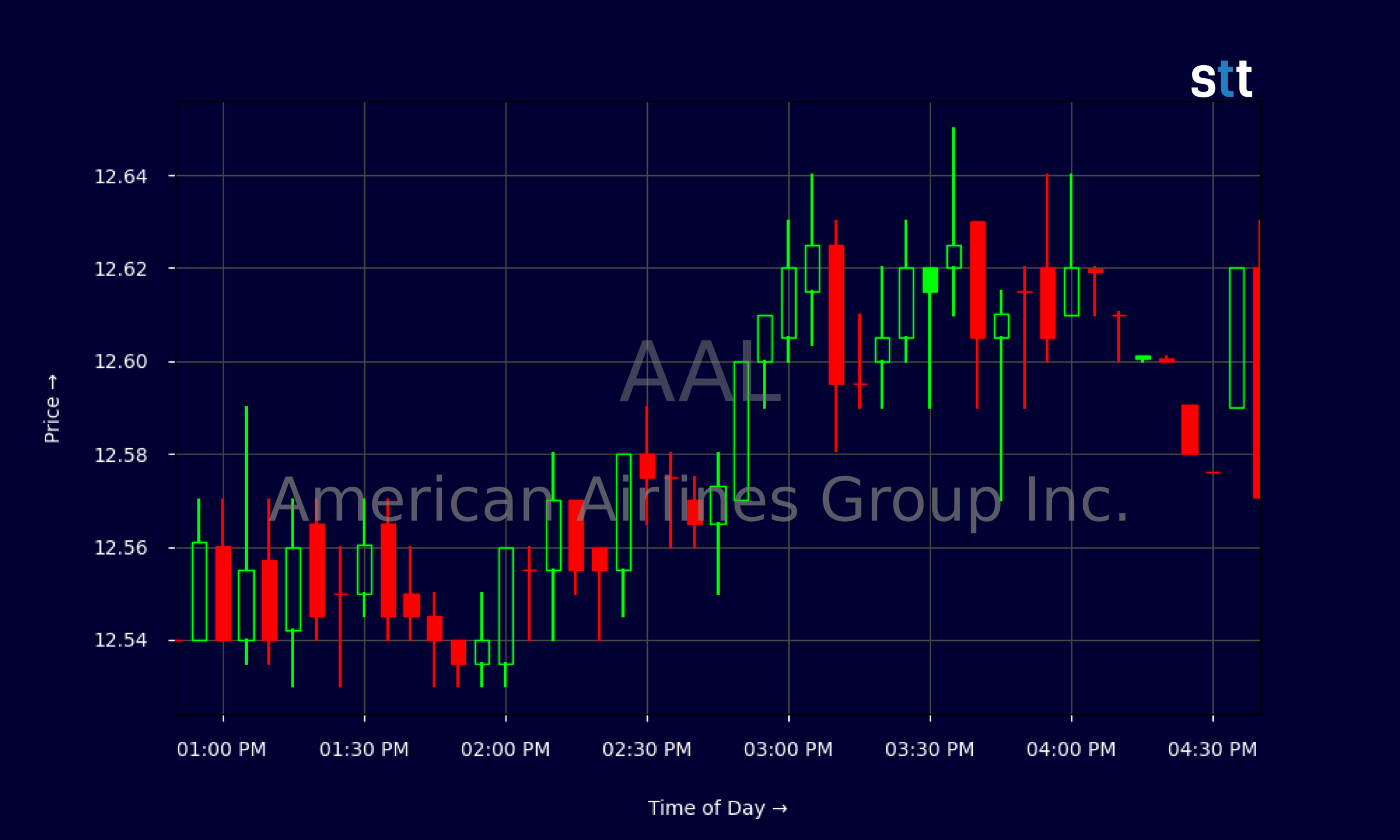
Live Update At 16:48:48 EDT: On Tuesday, October 27, 2026 American Airlines Group Inc. stock [NASDAQ: AAL] is trending up by 3.03%! Discover the key drivers behind this movement as well as our expert analysis in the detailed breakdown below.
Quick Financial Overview
On the chart, AAL has been grinding sideways with a bullish lean. From 2026/10/02 to 2026/10/27, American Airlines shares slipped from around $12.94 to $12.61, but the path matters. The stock bounced off lows near $11.68 on 2026/10/19 and has since pushed back into the mid‑$12s, with multiple closes around $12.60–$12.80. That tells traders dip buyers are defending this zone.
Intraday, AAL’s 5‑minute tape shows a tight range between roughly $12.53 and $12.65 late in the session, with steady bids holding every minor pullback. This kind of compression after news often sets up the next move. For short‑term trading, American Airlines is acting like a stock consolidating after a catalyst, not one in free‑fall.
More Breaking News
- OPEN Stock Slips As Traders Focus On Cash Burn And Support
- Pentair Stock Rebounds As Analysts Reset Price Targets
- RKT Stock Holds Range As Housing Headwinds Meet Fintech Moves
- CLRO Stock Rockets On Massive Volume As Traders Pile In
Fundamentally, AAL is a high‑debt, low‑margin name. Revenue over the last year sits near $54.63B, with an EBIT margin around 2.2% and a profit margin still negative. The balance sheet shows about $31.55B of long‑term debt and weak liquidity, with a current ratio of 0.5. For traders, that means American Airlines is highly sensitive to macro shocks and fuel swings, which can turn a good quarter bad very quickly.
Why Traders Are Watching AAL Right Now
The latest earnings from American Airlines are exactly the kind of mixed story active traders love. AAL printed record Q3 revenue of $16.34B, slightly above the $16.21B consensus. Adjusted EPS of $0.28 crushed expectations for a $0.36 loss. Demand is not the problem. Premium cabins are selling, and the commercial team is squeezing more dollars out of every seat.
The problem is fuel. American Airlines saw fuel expense jump 67.5% year over year. Management went as far as saying AAL would have been “solidly profitable” without that spike. For chart watchers, that line matters: the core business is throwing off cash, but one variable cost is swinging the P&L.
Analysts are reacting the same way traders are. Morgan Stanley cut its AAL price target to $22 from $24 but kept an Overweight rating after the beat, pointing out that American Airlines plans to slow growth to keep fuel exposure in check. Bernstein dropped its target to $19 from $23 while staying Outperform, and UBS trimmed to $16 from $17 with a Buy. All three are dialing back upside expectations without walking away from the story.
For AAL traders, that’s classic “cautious bullish.” The Street still sees room above current prices, but the rally script depends on two levers: strong travel demand and some relief on jet fuel. In that context, American Airlines’ 10% jump in spending on Citi co‑branded credit cards is a quiet but important win. Loyalty and co‑brand revenue tends to be higher margin and less volatile than selling seats, which gives AAL another tool to offset fuel pain.
Management is also playing the long game. American Airlines laid out 2027 priorities centered on raising unit revenue — better pricing, better mix, smarter network choices. On top of that, AAL said it will “keep our eyes open” on M&A. No specific deals, but the door is open to consolidation, which has often supported pricing power in past airline cycles.
Conclusion
For active traders, AAL now sits at the crossroads of strong demand and brutal fuel costs. The stock’s recent action around $12–$13 reflects that tug‑of‑war. On one side, American Airlines is printing record sales, beating revenue and earnings expectations, and growing high‑margin Citi card spend by 10% year over year. On the other side, a 67.5% fuel expense jump flipped the quarter into a loss and forced AAL to talk more about cost discipline and slower growth.
This is also a sector story. Peers like Delta, United, Alaska, and Southwest are all dealing with the same jet fuel pressure and a market laser‑focused on capacity control. In that race, traders are watching which carrier manages fuel, balance sheet risk, and pricing the best. American Airlines’ heavy debt load and thin margins raise the stakes, but they also make AAL more responsive to any improvement in fuel or fares.
Analyst calls underline the trade. With Morgan Stanley, Bernstein, and UBS all cutting targets yet sticking with positive ratings, the message is clear: American Airlines is a leveraged bet on fuel and travel demand, not a broken business. That setup naturally attracts short‑term trading strategies — breakout players, dip buyers, and even short sellers.
As Tim Sykes likes to say, “The market doesn’t care about your opinion; it cares about the catalyst and the chart.” That perspective lines up closely with a momentum‑driven approach: as Tim Bohen, lead trainer with StocksToTrade says, “I focus on momentum that’s visible right now. Speculation on future moves is outside my playbook.” For AAL, the catalysts are fuel prices, revenue records, and any hint of sector consolidation. The chart shows consolidation after news. Traders’ job now is to map their risk, watch the levels, and let American Airlines’ next catalyst choose the direction.
This is stock news, not investment advice. StocksToTrade News delivers real-time stock market updates tailored to highlight the key catalysts driving short-term price movements. Our coverage is designed for active traders and investors who thrive in fast-moving markets, with a focus on volatile sectors like penny stocks, AI stocks, Robinhood stocks and other momentum plays. From earnings reports and FDA approvals to mergers, new contracts, and unusual trading volume, we break down the events that can spark significant price action.
Looking to level up your trading game? Explore StocksToTrade, the ultimate platform for traders. With powerful tools designed for swing and day trading, integrated news scanning, and even social media monitoring, StocksToTrade keeps you one step ahead.
Check out our quick startup guide for new traders!
- How to Read Stock Charts: A Guide for Beginners
- Trading Plan: 6 Steps to Create One
- How To Create a Stock Watchlist
Ready to build your watchlists? Check out these curated lists:
Once your watchlist is set, take the next step and trade with confidence using StocksToTrade’s robust platform. Don’t miss out — grab your 14-day trial for just $7 and experience the edge you need to thrive in today’s fast-paced markets.