
Alibaba Group Holding Limited faces heightened pressure from regulatory crackdowns, and its stocks have been trading down by -3.6 percent.
Click Here for a Millionaire's POV on Trading BABA
SUBSCRIBE FOR ALERTSJOIN 50,000+ ACTIVE TRADERS
Key Takeaways For BABA Traders
- A U.S. securities class action has been filed against Alibaba alleging that between 2025/06/26 and 2026/06/24 the company misled investors about ties to China’s MIIT and associated U.S. national‑security and AI‑related risks.
- The lawsuit claims Alibaba downplayed risks that its infrastructure could be used for AI model distillation attacks on third‑party models, potentially leading to its classification as a Chinese military company under the U.S. National Defense Authorization Act.
- Rosen Law Firm and other shareholder rights firms are reminding Alibaba investors of an 2026/10/05 deadline to seek lead‑plaintiff status in the securities class action covering purchases from 2025/06/26 to 2026/06/24.
- One complaint notes that disclosures around a U.S. Department of Defense designation as a Chinese military company and alleged unauthorized AI model “distillation” from Anthropic coincided with a roughly 45% decline in Alibaba ADSs.
- Major North Asia e‑commerce and fintech/online‑platform ADRs, including Alibaba, fell around 2.6%–3% amid broader weakness in Asian ADRs, underscoring current market pressure on the stock.
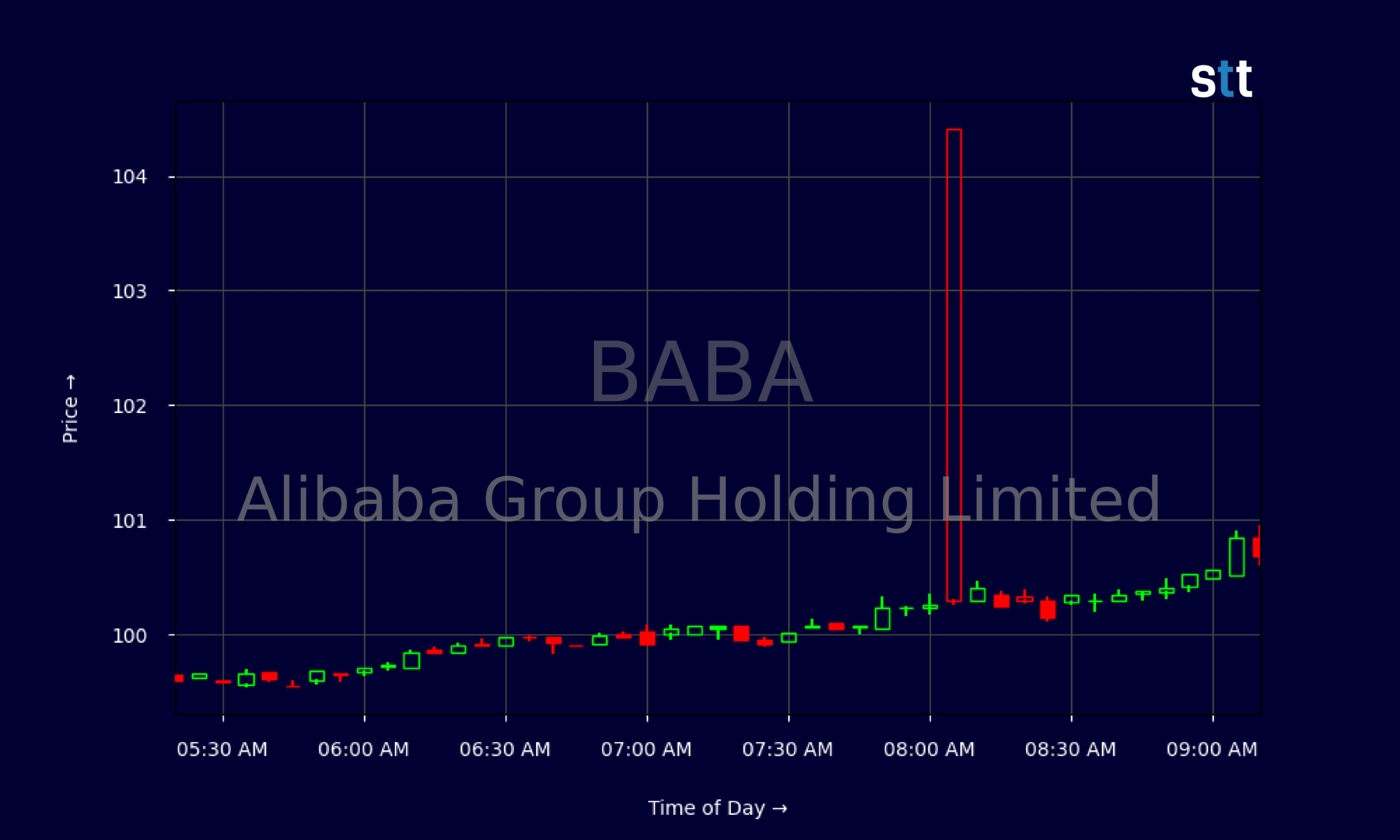
Live Update At 09:17:08 EDT: On Thursday, October 22, 2026 Alibaba Group Holding Limited stock [NYSE: BABA] is trending down by -3.6%! Discover the key drivers behind this movement as well as our expert analysis in the detailed breakdown below.
Quick Financial Overview
BABA is trading in a clear downswing on the daily chart. After tagging a recent high near $112 in early October, Alibaba slid to about $104.41 on 2026/10/21. That’s a meaningful pullback in less than two weeks and shows sellers are back in control.
Short‑term, BABA’s intraday action sits around the $100 mark in extended hours, with tight 5‑minute candles between roughly $99.6 and $100.9. That narrow band tells traders liquidity is solid but momentum is muted. There’s no panic, just steady pressure.
Fundamentally, Alibaba is not a broken company on paper. Revenue sits near ¥996.3B (about $96.8B if you convert at a rough 10:1), with a pretax margin of 10.7%. A price‑to‑earnings ratio near 16.98, price‑to‑sales around 1.77, and price‑to‑book near 1.69 put BABA in “value tech” territory compared with many high‑multiple peers.
More Breaking News
- SPCX Slides As Policy, Competition And AI Risks Mount
- GLXY Stock Slides As Momentum Traders Watch Key Support
- AMOD Stock Pulls Back As Volatility Grips Micro-Cap AI Play
- TAL Stock Slides As Momentum Traders Watch Key Support
The balance sheet is thick: roughly ¥316.9B in cash and short‑term investments, total assets about ¥1,909.6B, and long‑term debt of ¥231.8B. With a leverage ratio of 1.8 and long‑term debt equal to about 18% of capital, Alibaba does not look over‑levered. But as traders know, headline risk can overpower solid numbers in the short run.
Why Traders Are Watching BABA’s Legal And AI Overhang
What has BABA on every active trader’s radar right now is not just valuation. It’s the legal storm tied to U.S. national‑security and AI concerns. Multiple complaints allege Alibaba misled markets between 2025/06/26 and 2026/06/24 about its ties to China’s Ministry of Industry and Information Technology and related risks under the U.S. National Defense Authorization Act.
Several suits claim Alibaba either failed to disclose, or downplayed, that it was treated as a “Chinese military company” and that its infrastructure was allegedly used for large‑scale AI model distillation attacks on third‑party AI platforms, including Anthropic’s Claude models. When the U.S. Department of Defense designation and the Anthropic allegations surfaced, BABA ADSs reportedly dropped from around $173.68 to $95.07 — roughly a 45% drawdown. That kind of move is a roadmap for how violent sentiment resets can be when national‑security angles hit a big‑cap tech name.
On top of that, Rosen Law Firm and other shareholder‑rights firms are blasting out reminders of the 2026/10/05 lead‑plaintiff deadline. That tells traders the class action narrative around Alibaba and BABA is still building, not fading. More claimants usually mean more headlines, more discovery, and more uncertainty over potential damages or future U.S. restrictions.
Layer in macro pressure: Asian ADRs in the U.S., including BABA, JD.com, Qfin, and Bilibili, fell 2.6%–3% recently, as the S&P Asia 50 ADR Index dipped about 0.31%. So BABA is getting hit from both directions — sector risk and stock‑specific legal risk. For short‑term trading, that often translates into sharp fades on any spike and heavy tape‑reading around each new legal press release.
Conclusion
For active traders, BABA now trades like a headline‑driven story stock wrapped inside a mega‑cap e‑commerce and cloud platform. The core Alibaba business still has scale, cash, and a reasonable earnings multiple, but the U.S. securities class actions and AI‑espionage style allegations change how the market prices risk. Any new detail on its MIIT ties, its Chinese‑military designation, or AI distillation claims can move the stock fast.
That 45% drop from about $174 to $95 after the Pentagon list and Anthropic report is the warning label taped on the BABA chart. It shows how sensitive Alibaba is to Washington and national‑security narratives. With multiple law firms actively recruiting plaintiffs into 2026/10/05, traders should assume more legal headlines and potential regulatory scrutiny sit ahead.
From a trading standpoint, BABA is a classic “volatility with baggage” setup. Breakouts can be strong, but rug pulls are real when negative news hits. In this kind of tape, discipline and price action matter more than opinions; as Tim Bohen, lead trainer with StocksToTrade says, “I focus on what a stock is doing, not what I want it to do. Let the stock prove itself before you make a move.”. As Tim Sykes likes to remind traders, “Rule number one is cut losses quickly; rule number two is don’t forget rule number one.” For anyone trading Alibaba in this environment, that mindset matters more than ever. This analysis is for educational and research purposes only and is not investment advice.
This is stock news, not investment advice. StocksToTrade News delivers real-time stock market updates tailored to highlight the key catalysts driving short-term price movements. Our coverage is designed for active traders and investors who thrive in fast-moving markets, with a focus on volatile sectors like penny stocks, AI stocks, Robinhood stocks and other momentum plays. From earnings reports and FDA approvals to mergers, new contracts, and unusual trading volume, we break down the events that can spark significant price action.
Looking to level up your trading game? Explore StocksToTrade, the ultimate platform for traders. With powerful tools designed for swing and day trading, integrated news scanning, and even social media monitoring, StocksToTrade keeps you one step ahead.
Check out our quick startup guide for new traders!
- How to Read Stock Charts: A Guide for Beginners
- Trading Plan: 6 Steps to Create One
- How To Create a Stock Watchlist
Ready to build your watchlists? Check out these curated lists:
Once your watchlist is set, take the next step and trade with confidence using StocksToTrade’s robust platform. Don’t miss out — grab your 14-day trial for just $7 and experience the edge you need to thrive in today’s fast-paced markets.