
Advanced Micro Devices Inc. stocks have been trading up by 5.26 percent amid optimism over accelerating AI chip demand.
Key Takeaways Traders Need To Know
- Q4 revenue guidance of about $17B (±3%) tops the $16.14B consensus, signaling ~66% year-over-year and 27% sequential growth with roughly 55% non-GAAP gross margin.
- In Q3, AMD beat expectations on EPS and revenue as data center sales nearly doubled, powered by strong Instinct and EPYC demand and the ramp of Helios and “Venice.”
- Management sees data center revenue growing faster in Q4 and topping 80% of total revenue by FY27, with server revenue set to double year-over-year in FY27 and AI data center growth running even hotter.
- The company locked up most of Samsung’s Taylor, Texas output for base dies used in high-bandwidth memory, shoring up supply for its AI and data center roadmap.
- Major Wall Street firms stayed bullish after Q3, with Goldman Sachs holding a $700 target and Susquehanna lifting its target to $650 on AMD’s data center strength and MI450/Helios GPU ramp expectations.
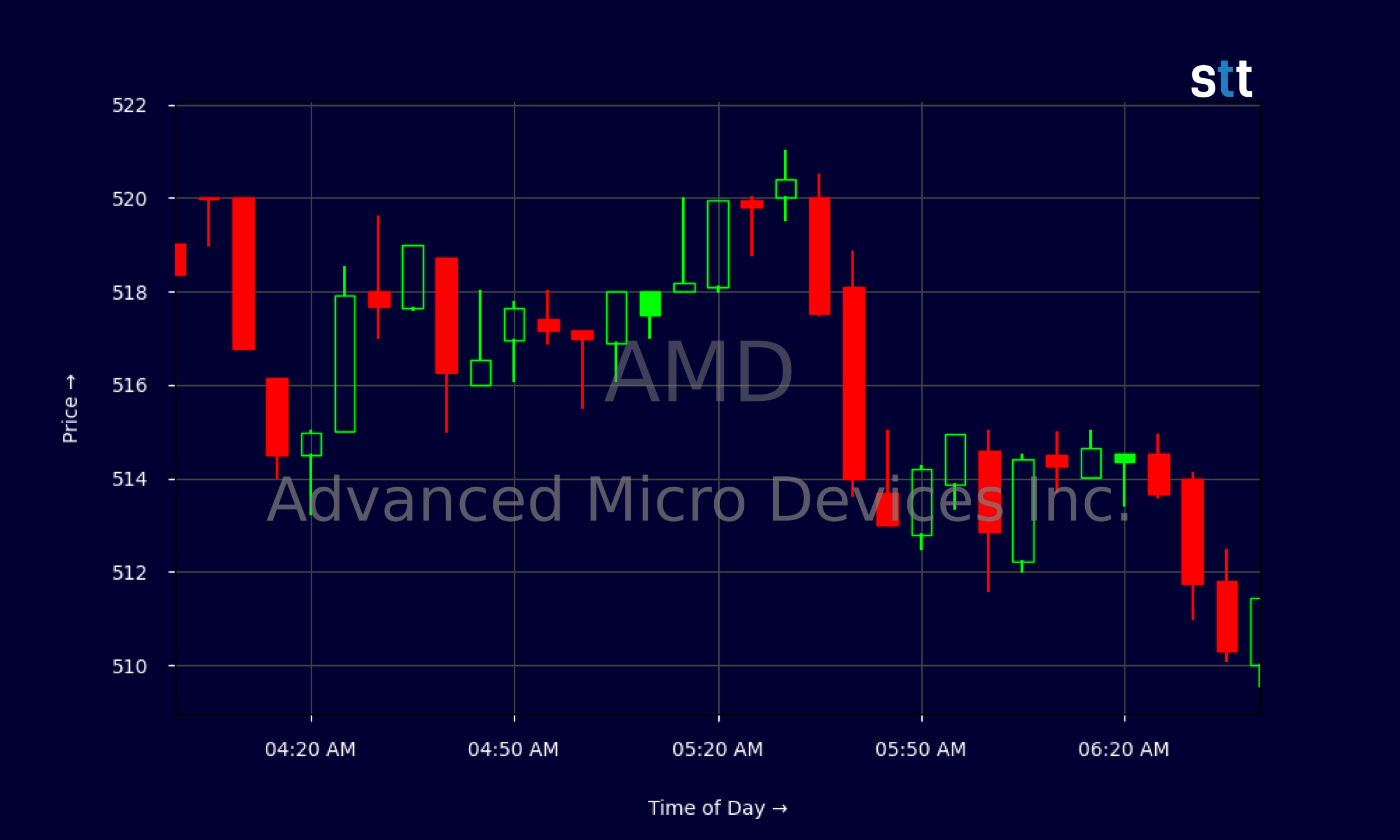
Live Update At 06:48:08 EST: On Wednesday, November 04, 2026 Advanced Micro Devices Inc. stock [NASDAQ: AMD] is trending up by 5.26%! Discover the key drivers behind this movement as well as our expert analysis in the detailed breakdown below.
Quick Financial Overview
AMD is trading like a full‑throttle momentum name, and the numbers back that up. Recent daily action shows the stock swinging between the mid‑$500s and just under $600, with a pullback toward $480–$510 as traders digest the latest earnings spike. That kind of range tells you volatility is alive and well.
Intraday, AMD’s tape shows tight five‑minute candles mostly between $510 and $520, with quick pops and fades. This is classic post‑news consolidation: strong hands holding, weak hands scalping pennies. For active trading, those intraday levels become clear support and resistance zones.
On the fundamentals, AMD just printed about $34.6B in trailing revenue with a hefty 53.2% gross margin and an EBIT margin near 18.8%. The balance sheet is clean, with total debt to equity around 0.06 and a current ratio of 2.6, giving AMD plenty of room to keep spending on AI growth.
More Breaking News
- EPAM Stock Climbs As Wall Street Lifts Price Targets
- FTCI Stock Pops As Credit Relief Meets Solar Tech Tailwind
- SK Hynix Rises 6% After Recent Pullback
- Unity Software Stock Jumps As Google AI Deal Electrifies Bulls
Valuation is rich — a P/E above 150 and price‑to‑sales around 24 — which means traders are paying up for future AI cash flows, not today’s earnings. As long as the growth narrative holds, momentum players will keep crowding into AMD, but extended valuations can turn fast if the story slips.
Why Traders Are Watching AMD’s AI Data Center Surge
The core of the AMD story right now is simple: data center, not PCs, is running the show. In Q3, AMD beat Wall Street on both adjusted EPS and revenue. Data center revenue hit $8.55B, topping the $8.23B consensus, while the client segment slipped slightly under expectations at $2.95B versus $3.05B. That split tells traders exactly where the real engine is — EPYC CPUs and Instinct AI GPUs in the cloud and AI stacks.
Management doubled down on that narrative with Q4 guidance. AMD is calling for about $17B in Q4 revenue, far above the $16.14B consensus and implying roughly 66% year‑over‑year and 27% sequential growth, with non‑GAAP gross margins near 55%. That is not modest acceleration — it is a reset higher in what the market thought AMD could deliver.
Looking out further, AMD told the Street it expects data center revenue to grow faster in Q4 and rise to over 80% of total company revenue by FY27. The company projects server revenue to double year over year in FY27, with AI data center revenue growing even faster than it forecast just 90 days earlier. For traders, that is textbook “raise the bar and clear it” behavior, the kind of guidance trend that supports extended rallies.
On top of demand, AMD is working the supply side. The company has secured most of the output at Samsung’s Taylor, Texas plant for base dies used in high‑bandwidth memory. HBM has been a choke point across AI hardware, so this lock‑up gives AMD better visibility and reduces the risk that supply constraints cap upside just as demand ramps. In a crowded AI trade, tangible moves like this help AMD stand out from weaker hands that are still scrambling for capacity.
Conclusion
For active traders, AMD now sits at the intersection of three powerful forces: explosive AI data center demand, aggressive multi‑year guidance, and confirmation from the tape. Shares jumped about 6% in after‑hours trading after the Q3 report and bullish Q4 outlook, showing that the market not only heard the story but believed it enough to chase.
Management is guiding to more than 80% revenue growth by FY27 versus current levels, with Street revenue expectations circling roughly $89.9B, even while AMD assumes the broader PC market will fall by double digits in 2027. That tells traders AMD is leaning hard into higher‑margin, higher‑growth arenas while letting legacy headwinds roll off its back.
Wall Street is lining up behind that view. Goldman Sachs kept a Buy rating and a $700 target after Q3, pointing to data center strength, gross margin upside, and tight operating costs. Susquehanna pushed its AMD target to $650 and highlighted data center demand and upcoming MI450/Helios GPU ramps starting in Q4 2026 and into 2027. That kind of clustered, high‑end target range often acts as a psychological magnet in momentum trading.
For traders in the Tim Sykes community, the playbook is familiar: respect the trend, but never fall in love with the stock. As Tim likes to say, “The market rewards preparation, not prediction.” That mindset lines up closely with the broader trading discipline in the community — as Tim Bohen, lead trainer with StocksToTrade says, “The best trades are the ones you can make without emotion. Plan it, then execute it as if it’s routine.”. AMD’s story right now is all about preparation — securing supply, scaling AI hardware, and guiding higher. The job for traders is to track the levels, watch the volume, and be ready to cut losses fast if the narrative or the chart breaks. This article is for educational and research purposes only and is not investment advice.
This is stock news, not investment advice. StocksToTrade News delivers real-time stock market updates tailored to highlight the key catalysts driving short-term price movements. Our coverage is designed for active traders and investors who thrive in fast-moving markets, with a focus on volatile sectors like penny stocks, AI stocks, Robinhood stocks and other momentum plays. From earnings reports and FDA approvals to mergers, new contracts, and unusual trading volume, we break down the events that can spark significant price action.
Looking to level up your trading game? Explore StocksToTrade, the ultimate platform for traders. With powerful tools designed for swing and day trading, integrated news scanning, and even social media monitoring, StocksToTrade keeps you one step ahead.
Check out our quick startup guide for new traders!
- How to Read Stock Charts: A Guide for Beginners
- Trading Plan: 6 Steps to Create One
- How To Create a Stock Watchlist
Ready to build your watchlists? Check out these curated lists:
Once your watchlist is set, take the next step and trade with confidence using StocksToTrade’s robust platform. Don’t miss out — grab your 14-day trial for just $7 and experience the edge you need to thrive in today’s fast-paced markets.