

My entire trading philosophy is built around a “go or no-go” strategy.
There are no emotions, no guessing, and no waiting around for paint to dry. This is my favorite day-trading strategy for new or part-time traders.
“Loaded Spring” Setup Can Turn Sleeper Stocks Into 20%+ Runners In Minutes

Table of Contents
The Big Picture
Part-time traders don’t have time to stare at a screen all day. They’re still working a regular job. If that’s you, you’re going to love the “go or no-go” strategy.
The best part is that it’s simple. That’s the beauty of my whole trading philosophy.
We Only Buy At Key Levels
The whole idea is that we buy only at very specific levels. Why? Because those levels typically create an immediate reaction.
We don’t buy weak or sideways stocks. We buy at pivotal levels because that gets us into and out of the trade as fast as possible.
Now, that might mean getting stopped out, okay? And this is where new traders often get stuck.
If I’m going to get stopped out, I want to get stopped out as quickly as possible.
If it’s going to be a loss, why would I want it to take hours, days, or weeks?
Now, don’t misunderstand. Yesterday I said that real trading is 95% waiting.
That’s true… BEFORE you get into the trade.
Let’s use a stock from the watchlist earlier this week as an example.
BRAI: Regular Hours No-Go
Braiin Limited (NASDAQ: BRAI) was my watchlist stock here on Wednesday. You might remember this chart:
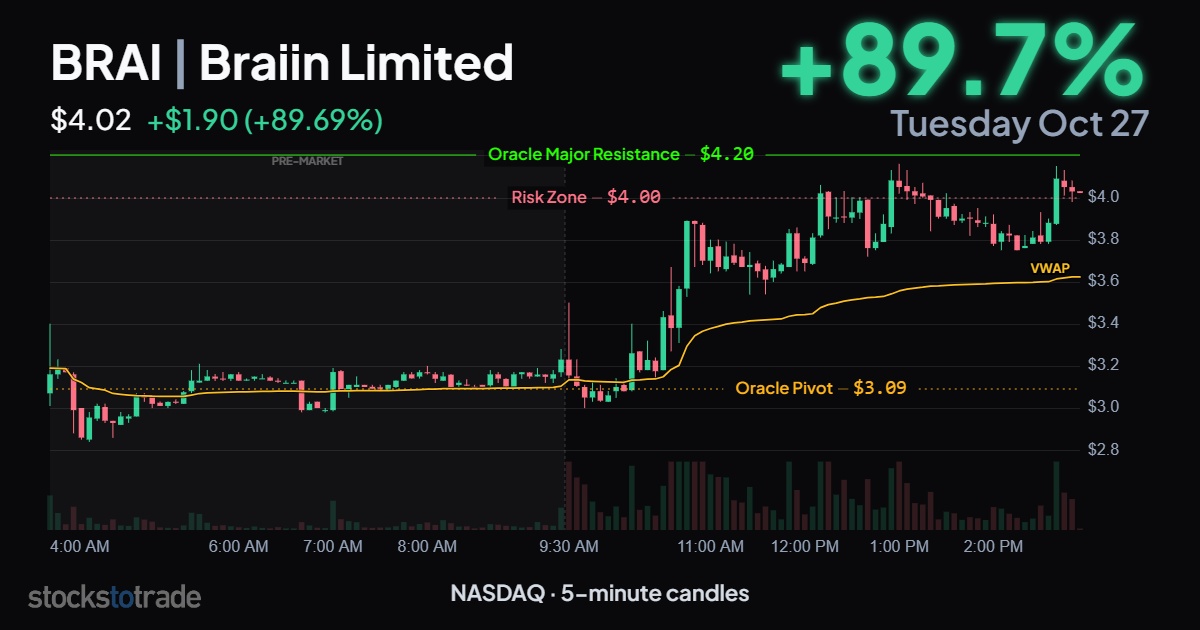
BRAI 10/27/26 morning to midday, Double Down trade plan
This was my trade plan:
Entry: $4.20 (Oracle major resistance at the time I was writing)
Risk: $4 (the nearest whole/half dollar level)
Target: the next Oracle resistance level in the $4.90s.
BRAI didn’t wait until Wednesday, but it’s still very informative. Let’s take a look at what happened going into the close on Tuesday. Remember, it’s always go or no go…
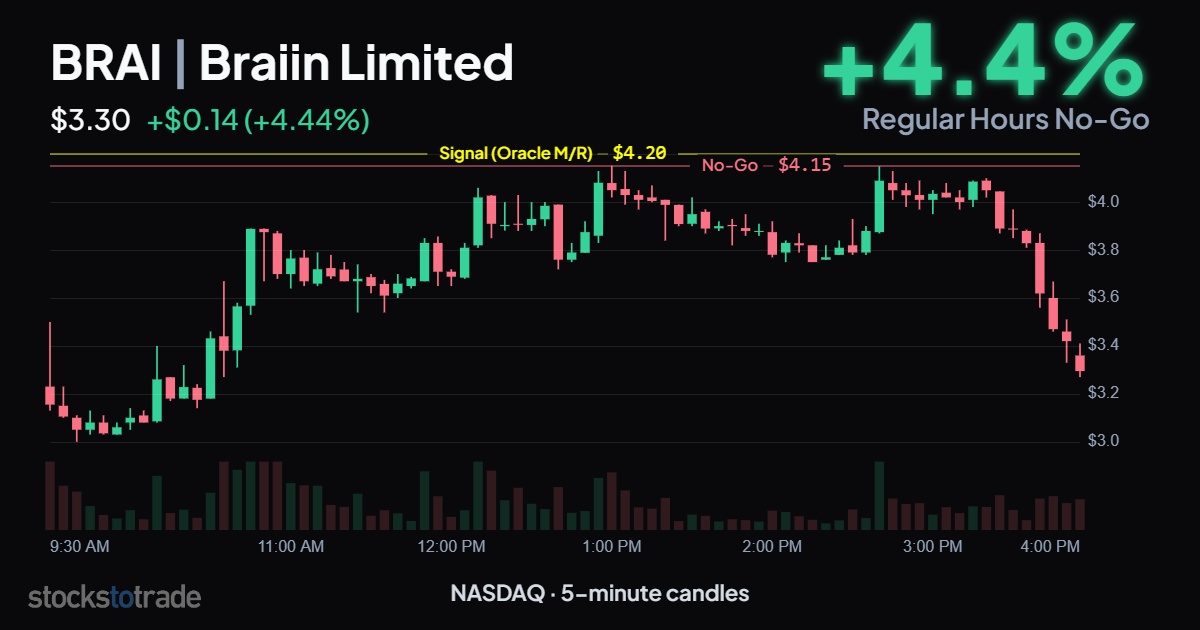
BRAI 10/27/26, regular hours no-go
The push to $4.15 around 2:45 p.m. was just short of the signal.
No signal, no trade. You just wait.
Then, into the close, it dumped all the way down to $3.27.
Now, if you used the go or no-go philosophy, you lost nothing. You just sat there and waited. But anyone who traded that chop got hurt.
Better yet, you set an alert so you didn’t have to sit and stare at the chart because it looked like it was done, right?
Until it did this…
BRAI After-Hours Go
In after-hours trading, BRAI started grinding back. At 7:03 p.m., it hit the $4.20 signal. Look at how it reacted:
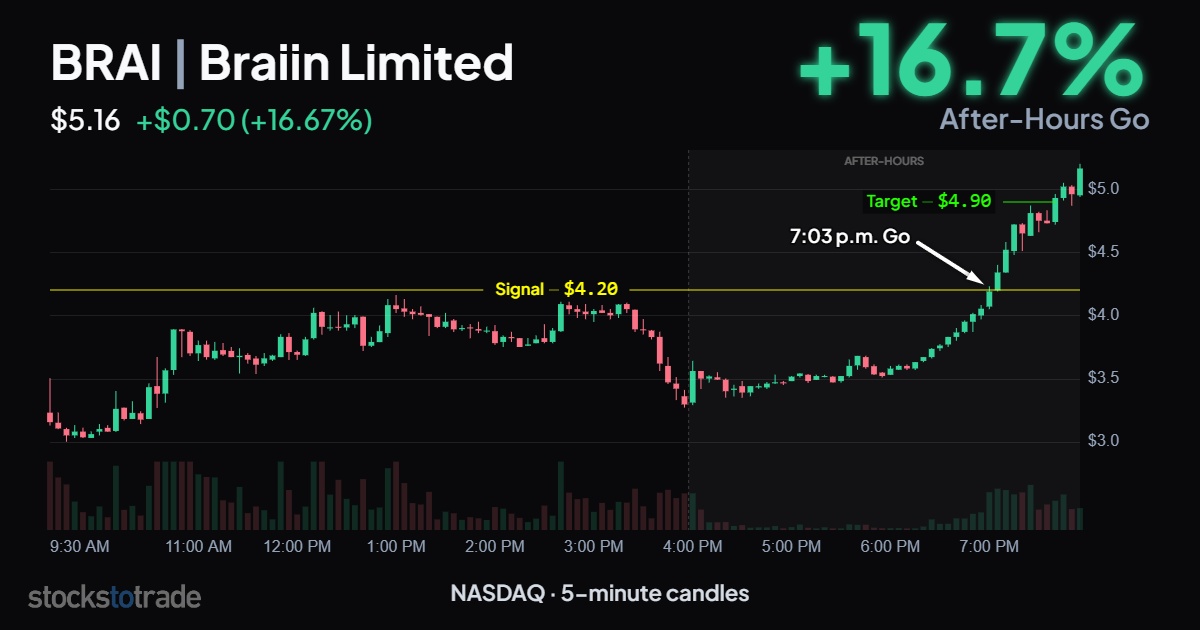
BRAI 10/27/26, 5-min candles, after-hours go
Right at $4.20, both volume and price action sped up. It hit the target within 41 minutes without ever coming close to the risk zone.
The go or no-go strategy is simple:
- Buy at the signal
- Sell at the target
- If it hits the stop, you cut it
That’s the whole system. You don’t need to stare at the screen all day. You don’t need to guess where to enter. And you don’t need to predict.
There’s a very specific price level where it’s a go. If it doesn’t get there, it’s a no-go.
My Take
If you get into a trade without a planned entry at a key level, you’re playing guessing games.
Now, if you’re trading a big account, that might not matter. But if you’re trading with a small account, and another trade comes along, guess what? You can’t trade it because you don’t have the buying power.
My suggestion is to use a go or no-go strategy based on key levels. Especially if you’re new.
Watchlist
Hyperliquid Strategies Inc (NASDAQ: PURR) spiked in premarket yesterday (Oct. 29) after its native HYPE token rallied to gain over 18%.
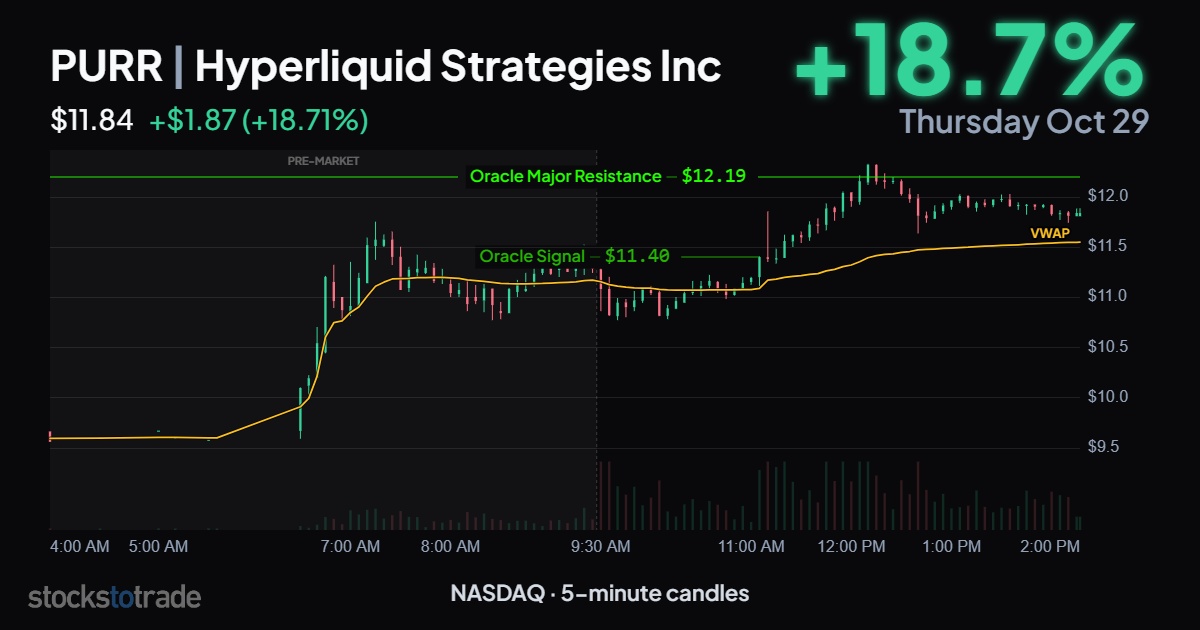
PURR 10/29/26, 5-min candles, Oracle signal and major resistance
PURR hit both the Oracle signal and target yesterday. Then it pulled back and respected VWAP in the afternoon.
I like breaks of that Oracle major resistance at $12.19, with risk near yesterday’s VWAP. For tighter risk, use the whole dollar level at $12. The next Oracle resistance at $13.68 is a solid target based on how much this can move.
On My Radar
- Google’s latest AI models, Genie 4 and Gemini 4 Carbon are incredible
- Meanwhile, parent company Alphabet (NASDAQ: GOOGL) dropped ~12% after it missed on earnings
- Make this trade at 9:30AM on Monday