
Out of the entire canon of patterns I teach and trade, the dollar cross is the simplest.
It also gets the most pushback. People see how it works and say…
“Trading can’t be this simple, can it?”
Once you see how it works, it’ll change the way you approach trading forever
Table of Contents
The Big Picture
The idea behind the dollar cross play isn’t new. In fact, legendary trader Jesse Livermore called it the Century Mark Rule in the early 1900s.
But I imagine even Jesse Livermore would be surprised at how reliable it is with low-priced stocks in today’s market.
First, let’s look at the dollar cross criteria. Then, I’ll break down a beautiful example from Friday (Oct. 9) and how you could have traded it.
Dollar Cross Criteria
This is what I look for to identify a potential dollar cross play:
- Price between 50 cents and $1
- The stock gaps up
- Unusual volume
- Float rotation
- Confirmation (the stock doesn’t break down)
Now let’s take a look at Friday’s beautiful dollar cross play…
Why JZ Was a Prime Candidate for the Dollar Cross
First, understand that Jianzhi Education Technology Group Company Limited (NASDAQ: JZ) was a big runner on Thursday:
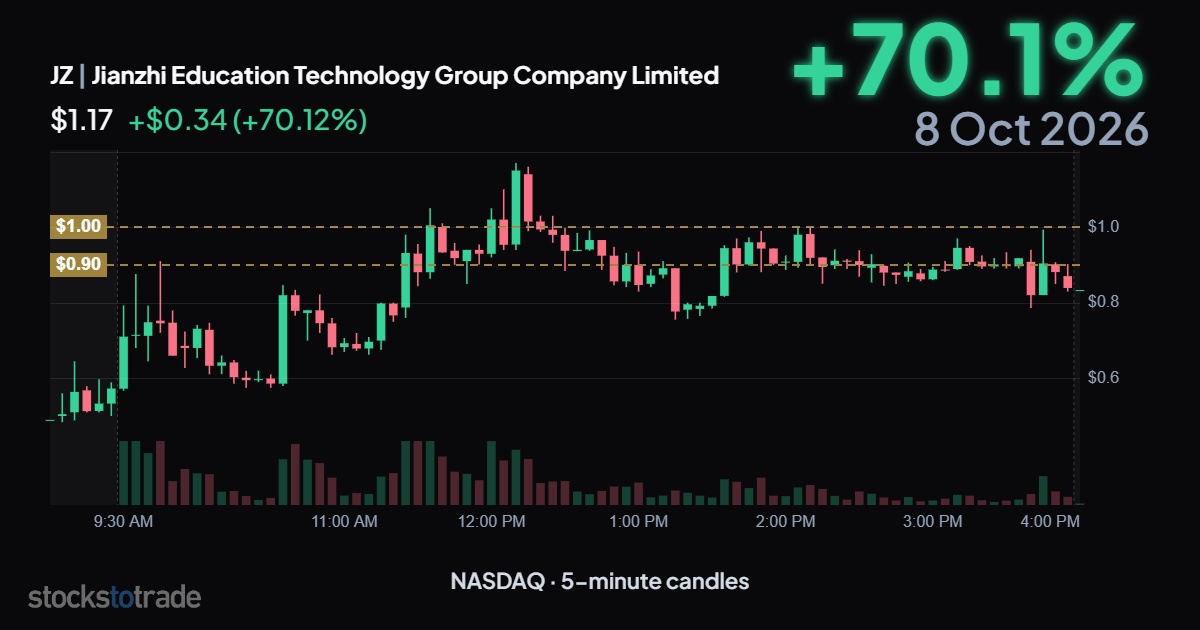
JZ 10/8/26, 5-min candles, day one runner
JZ crossed $1 on Thursday and then pulled back. More importantly, it held through the close.
I often refer to day-1 runners as the penny stock du jour because they offer extreme volatility.
Now, stocks that spiked the previous day and hold into day 2 are potential multiday runners. And what I love about multiday runners is that the win rate often goes way up.
With that in mind, let’s add Friday’s action to the chart:
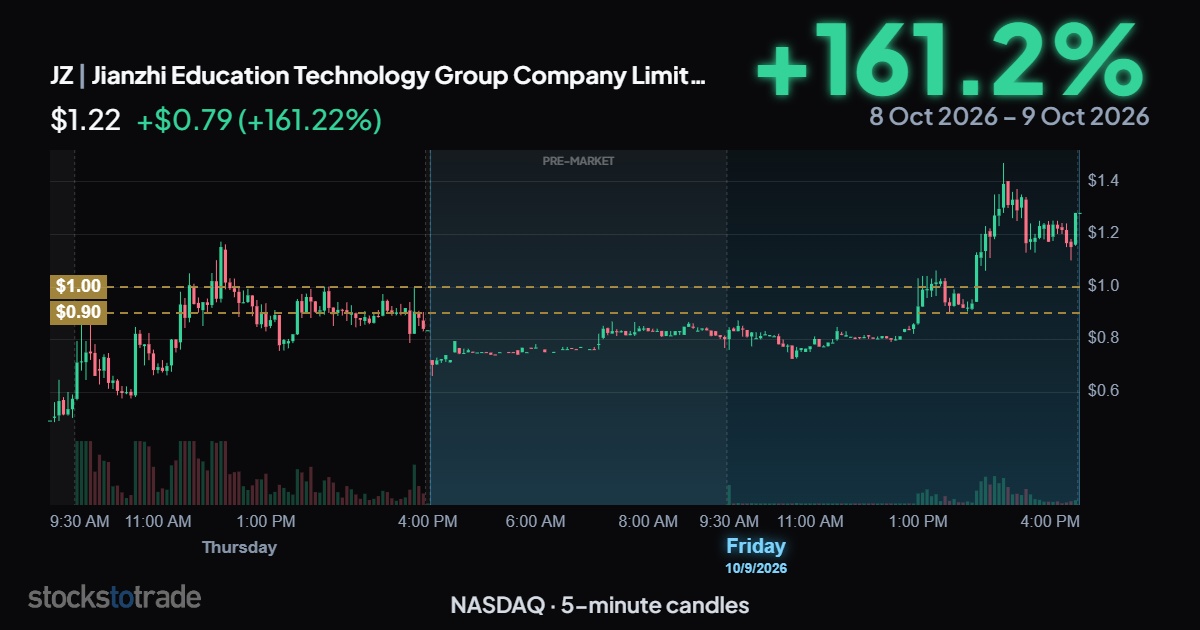
JZ 10/8-9/26, 5-min candles
JZ did not gap up on Friday. But at 7 a.m. ET, when most retail brokers open for trading, it was still holding most of its gains.
It also kept butting up against resistance just under 90 cents. I mentioned on the Pre-Market Prep webinar to keep an eye on JZ for a potential day 2 continuation. In particular, we talked about the dollar cross.
Let’s break JZ down according to the criteria:
- Price: it was between 50 cents and $1, but hit resistance at 90 cents
- It did not gap up: this is the only box it didn’t check (it did gap up Thursday morning)
- Volume: It traded unusual volume on Thursday (287M shares) and Friday (43M shares)
- Float rotation: Thursday’s action was 124x float rotation
- Confirmation: JZ didn’t break down
The Dollar Cross Trade
This is the part where most people push back because the trade plan is so simple:
- Set your risk at 90 cents
- Buy when the stock crosses $1 (say, $1.01 or $1.02)
- Sell one third at $1.20 (and raise your stop loss to $1)
- Sell another third at $1.30 (and raise your stop loss to $1.20)
- Let the final third run (raise your stop loss along the way)
- Sell the final third into major resistance or when it hits your stop
Now, you could trade a dollar cross even more conservatively by scaling out at $1.10, $1.20, and $1.30. Remember, the rule is: make your plan, trade the plan.
My Take
I love the dollar cross play because it is so simple. Calculating position size is easy because your risk going into the trade is always 10 cents a share. Plus, you can scale out to reduce risk as the stock goes higher.
Do dollar cross plays work every time? Obviously not. No pattern works 100% of the time. But if you work on this pattern, I think you’ll love it as much as I do.
If you want to know more about the dollar cross play, get the master class here.
Watchlist
Mobile-health Network Solutions (NASDAQ: MNDR) was yesterday’s penny stock du jour. It did the dollar cross in premarket trading and kept going into the afternoon.
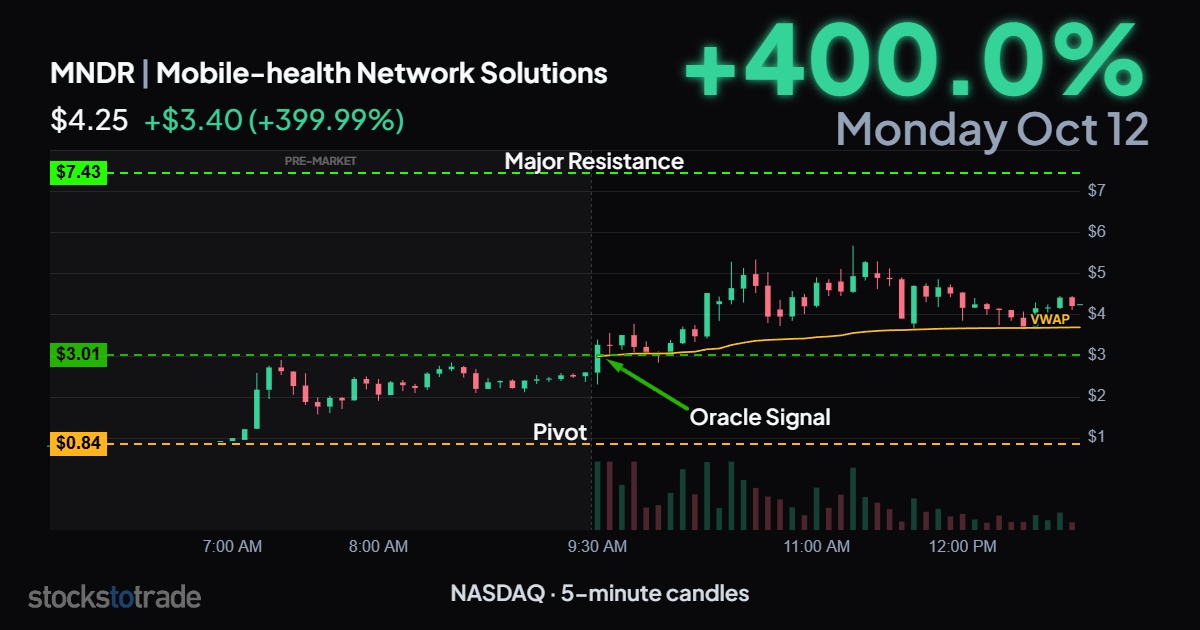
MNDR 10/12/26, 5-min candles, day-1 runner, Oracle signal hit
MNDR has room to run before it hits major resistance at $7.43. If it continues to hold VWAP, look for a day 2 continuation move. Consider a break above $5 with risk on yesterday’s VWAP.
On My Radar
- Pay attention to the Consumer Price Index (CPI) number tomorrow
- France just experienced “the weaponization of food”
- Why eating red meat could prevent cancer (venison for the win)
- Get Jeff Zananiri’s Calendar Stock research for a ridiculously low $1